So, today I was talking to someone at uni (at one of those casual social events that happens on a Friday evening, which I attend because of being Cool. That special sort of Cool where you go to casual outdoor pub-based events but nonetheless apparently do not have anything better to do with your Fridays) to someone whom I'd met once before, 3 weeks previously, (and hello if you remembered the this URL and are reading, Easily-Amused-Matt) (Good Lord, I hope his name is Matt, otherwise how embarrassing. But you really can't refer to someone as "The Easily Amused Guy Who Was There That Friday That Time Wearing An Icebreaker Shirt And A Hamas Scarf, Presumably Not Politically, Who Said It Was A Good Thing That He And I Were At Different Clinical Scools Because I Would Be Tiring To Talk To More Often Than Weekly Or Whatever, You Know The Guy, I Think He Had Glasses"; it's not snappy at all, and it would be tiring to hyphenate, and also it totally wouldn't work in the vocative. Plus I'm really pretty sure his name was Matt). Anyway, he said that he remembered me, which is nice, if sometimes a smidgin unconvincing, and then said "so I hear you have a blog which is hilarious?".
Leaving aside the "Gosh! How nice! How flatteringly hyperbolic!" and the instant urge to disclaim any pretentions to hilariousness, this... this always surprises me. Firstly, because, seriously, you mean you actually do remember me? A part of me is always surprised, possibly because it so often fails to happen, especially among the Uni Folks, who are often hampered in their attempts to remember who I am by their own overwhelming indifference on the question of my existance. (Possibly this is unfair, and this is actually a thin veneer of Faux-Indifference masking a core of Really-Caring-A-Lot-ness, or something. Possibly this is just how they roll, sort of barring people until it's been over a year so that they've proved themselves worthy by virtue of persistence. Most likely, of course, is that this, like so many things, is all in my mind, and that people are actually being perfectly friendly and I'm merely failing to process that. I bet that happens some of the time, if not most. A bit of unfair prejudice, a bit of shyness on my and or their parts, a soupçon of misinterpretation, and before you notice it's all "huh, that chick, she has no idea who I even am, and we've totally spoken a bunch of times". In my defence, in my undergrad, I was often exposed to the ravages that are social occasions with SUDS people (Sydney Uni Drama Society! Solipsism for all!), so I'm probably overinclined to think that people are deliberately not seeing folks, because man, that was definitely the de rigeur way to interact with the non-thespians.) Anyway, when someone really remembers me when we've only met once, it always seems nice. Maybe this is odd in me, since obviously I remember meeting him (possibly mainly on account of that slightly odd remark about me being tiring), but to be honest, that's largely random, sometimes I remember meeting people with crystal clarity (that sort of crystal clarity where you remember that someone likes Thing X and would notice if they'd changed their hair, but have not the faintest idea what their name is), other times, I just fail absolutely to remember people at all.
Secondly, it's always awfully flattering to be discussed in your absence. Like, it's already pretty neat when people remember you and talk to you and give the impression of thinking you reasonably likeable when you're there, but it's another thing entirely to have people discussing you when you aren't there to remind them that you exist. My Ever-Flattering-If-Occasionally-Inclined-To-Overdo-It Friend James said the other day that someone else had mentioned that I was a fan of the band Broken Social Scene on Saturday. Which, now I come to think of it, was a bit of a non sequitur anyway, given that I don't know what context there was for him to be all "we were discussing your music tastes the other day!", and also that I would describe my relationship with that band as being more towards the "Oh, I think I've heard of them, that's a band, right? They, uh, they sound... good?" end of the spectrum than otherwise. Nonetheless, the important point is that it somehow seems disproportionately flattering. Sort of "aw, you guys thought about me when I wasn't there? That's so nice!" Which, well, may be a little bit tragic, but hey, it's victimless tragicness, more or less. (Except for those of you who've been around for long enough that you've read blog posts about this same concept 3 times already. Sorry dudes.)
I'm always ridiculously curious about in what context it occurred, this alleged discussion of me (or "mentioning me at all"). Was it good? Were you playing some kind of game called "who is the niftiest person you can think of"? Presumably it's more that the band (or whatever) has come up and someone's gone, "I think Angela likes them, a lot of people do!" or similar. Although now I come to write it down, even this seems strange. That example, for instance, reads as if my putative opinion were the terribly important last word on the matter. Like "well, Angela likes them, so I think we'll all just have to face facts: they are clearly objectively good. I defy you to gainsay that girl's opinion!". This is just my writing, though, and should not be allowed to cause you to think that this is how I really imagine my friends behave. And thank goodness, you would rapidly come to resent someone always referrred to like that. Those of you who really like sad books and movies about torture would always be all angsty, for one thing.
I guess it must happen to everyone a lot of the time (being discussed, not being angsty because someone questions the validity of your liking of the Saw movies). I mean, what is there to talk about, really, except the people one knows? Or, in the case of magazies and so on, doesn't know? Sure, you can discuss yourself (cf. this blog), your interlocutor, the weather, and maybe current affairs if you're really brave and foolish enough to open the can of worms that so often is, but after that, all that's left is other people. Because mainly the landscape and so on is not all that eventful, so you can really only address the topic of "check out those crazy rocks, and what nice trees we've been having recently!" once or twice before people start being all "dude, what is it with you and the rocks? They're rocks. More interestingly, have you heard that a girl in our year is pregnant? You know the one, the one with the hair!".
Obviously, that would be marginally less desirable, that particular sort of being discussed, but don't even pretend that you don't sort of love the idea of being discussed too. The Aforementioned James always gets excited when I even so much as mention him on here (remember that one time I called him On-The-Ball James? Yeah, of course not, but he sure does, it took him most of a week to come down after that one. Clearly the world-wide fame of being read about by possibly up to 10 people went to his head). Similarly, Lovely Jenny checked whether I had been talking about her (because if so, how exciting!) one time I made a veiled reference to her. Obviously there's a bit of a downside, in that when I say things which are foolishly hyperbolic and abstract like "you would have to be naive to be totally unambivalent about anything really important and complex", people tend to read that as "you, Reader, personally, are naive, ha!", which obviously was not how that was ever meant to sound.
This is reassuring, now I think about it, since these 'ideas of reference'(which is a symptom of schizophrenia, but also, one suspects, of "being alive") are apparently a not-just-me thing. People are always concerned about how others talk about them. Surely. I suspect that this is a lot of the appeal of social networking sites like Facebook and Twitter, which allow us to enjoy the excitement of being talked about, and talking about people, without the hassle of first having to have a shower and change into something other than your pyjamas. I would mention here that Oscar Wilde said that "A life unexamined is not worth living" and that "the only thing worse than being talked about is not being talked about", but Oscar Wilde said of lot of thing like that, I think he was just a fan of that sort of pithiness. Also it didn't work out all that well for him, what with the whole scandal/imprisonment/destitute-but-witty-death-in-exile thing.
Thirdly (yes, we are still talking about that original conversation), mysterious and flattering is a great combination. So "some unnamed person told me that you were funny" is sort of ideal, in a sense. Especially when people are all "no I don't think it was Hyphenatedly-Entitled James, I think it was someone else talking about your amusing blog". Because, seriously? Who else would be reading? It's kind of like the mystery around this time last year, about the time of the Incident, except, y'know, good. I could understand if any of the last few posts had been of particularly high calibre, or if, conversely, they had maybe been shorter than usual, but as it is, I just still have difficulty picturing the hypothetical person who goes "my, I don't talk to that Angela girl all that often, but I sure do want to read 1,000 words of her overanalysing something that someone said to her at a pub this evening!". The harder I try to imagine it; the reader (not you, Reader, we're like this, you and I, some other reader) maybe settling in with a tasty beverage and a couple of hours of their life they have no further need of, just whiling away some time with a little benevolent stalkiness, the less convincing the whole picture becomes. (Possibly this is because I went overboard and gave the Hypothetic Reader there a Hugh Hefner-style dressing gown in my mind, but that's perfectly legit, since I know that at least one of my readers (which is to say, about 15% of my total readship) totally owns one of those.
I know I write long things, you see, so I'm just always surprised at the idea of anyone getting so far into one routinely enough that they think of it to talk about.
It's awfully nice of you, whoever you were!
Friday, May 21, 2010


Tuesday, May 18, 2010
In Which actions have consequences. Sort of.
This weekend, I managed to chip my tooth. Not badly, it was a pretty tiny chip, barely detectable to people whose mouths did not contain my tooth, but still in a way which was pretty obvious to me. Also, not in any exciting sort of way, such as in a brawl with a sabretoothed tiger, or catching a bullet with my teeth, or even just the more traditional but always classic getting-very-drunk-and-falling-down. Actually I just bit a fork on a weird angle at a wedding reception. (Yeah, I know, you'd think that after all these years I'd be passably adept at fork usage, but I'll have you know that forks are considered newfangled and classy and intimidating in the book I'm presently reading, so, uh, so there's that).
Anyway, leaving that aside, it was funny, because although it happened to be a mere tiny chip, it could so easily have been a crazy huge big-deal type of thing (although probably not as a result of poor fork angling. It was a wedding, though, anything could've happened, there was dancing, so I could easily have been spun into a pole and done some much more serious damage). But the point is, I was all "damn, that's a bit of a bugger, I'll have to get that sorted out early next week", not "oh man, this will sure change the way my face looks for the rest of my life, damn". When did this happen? Presumably before I was born. But definitely these things haven't always been fixable.
I mean, back in the day, tooth damage was it. Game over. You will now look like a hillbilly boxer for the rest of your life. I hope you enjoyed the last time you smiled at someone unselfconsciously, because that's it for that activity ever.
And it's not just teeth. Sometimes I catch myself going "dang, I feel like I've messed up my life/health/youth/whatever (not often, for those of you reading with a view to telling me that I'm too self-deprecating, this is a thing everyone does. If you do not ever ever do so, you are either very lucky or possibly a sociopath. I'm looking at you here, Always-Promptly-Friendlily-Critical-And-I-Guess-Conceivably-A-Sociopath James {Backstory for other Readers: James keeps telling me that my last posts have been too self-deprecating. Attempts to explain to him that they've really been more Tutor-Deprecating and Jack-Nicholson-Deprecating have been bizarrely ineffective}) and then going "oh well, I guess it's a write off, I'll do better next time". Like my life or health or whatever is a dress I plan to take back to the store after wearing it out of an evening, hoping they won't notice where I spilled something on it, and exchange for something more flattering, maybe in a nicer colour. (Note, I have never done that. I'm much too acquisitive. I want to keep all the dresses. All the nice dresses in the land. Also it seems Wrong.)
Is this that "Entitlement" we hear so much about, do you think? Do all of us, individually, and as a culture, expect for the consequences of all our actions to be reversible? (Like the Omega Thirteen in Galaxy Quest!) Seems plausible.
I spilled wine into my phone only a couple of weeks ago and had a very similar response, as if I were demanding restitution from the universe. "It was an accident, and therefore it is unfair for me to have to deal with the consequences." I went to get it fixed, because this is something you can just Do in this miraculous and consequenceless day and age, whereupon the dastardly repair guys charged me $90 to get it fixed. And here's the weird thing, even though that's a fortune (for me) to spend on something which isn't even fun, which doesn't add anything to your life except to bring you back to baseline, I handed it over serenely, because it was clearly not my fault (note: actually it clearly was), and therefore I would not be expected to bear the cost. (Obviously this was subconscious. I didn't really expect my parents or someone to magically decide to "pay me back" for the costs incurred. I have no idea what I thought was happening here.) And although the serenity was clearly some kind of unique one-off weirdness, I'm pretty sure that this is sort of how everyone feels.
Apparently this is a serious problem for people who narrowly avoid death. They feel like they've been saved for some higher purpose, and then feel gypped when they get to deathbed time without ever having the chance to dramatically save a small golden-haired child from an oncoming car/train/lion/Nazi. And people who have bad things happen to them feel like they've done their time and deserve things. I'm sure you do this too. Everyone seems to. You have a crappy day and feel all indignant if the next one is bad too, because you already had your bad day for this section of time. I definitely do that. Same thing as the phone and the tooth: I didn't mean for that bad thing to happen, I don't deserve that! (Ridiculous especially given how minor are my troubles in this instance. Oh no! Slight inconvenience and speedy restitution? You poor thing!)
This is weird, because I don't think of myself as someone who thinks of life being inherently or necessarily fair. Still apparently on some level I resent it when my accidental actions have consequences that actually affect me.
The book I am reading at present is called "The Name of The Rose". Reader, I beg you to suppress the urge to say whatever it is which it occurs to you to say when I say this, because it seems that everyone who doesn't respond "I've never heard of that book", has this overwhelming urge to spoil it as soon as you tell them that you're reading it. Apparently I'm leaving it too late to read for the first time, like some kind of literary equivalent of the Sixth Sense. Which I have also never seen. Even when my sister Alex was supposed to read it for a High School English text, but hadn't quite finished it over the holidays, her teacher began the first (first!) class on the text by describing it basically as "the book where Character X did it" or words to that effect. It's meant to be a mystery, but it seems sort of like the Scarlet Pimpernel (although not to that extent yet, mercifully, I'm managing to suspend what knowledge I was unable to avoid). The Scarlet Pimpernel is a wonderful book with a central mystery/twist which is spoiled on the cover of almost any copy of it printed in the last 50 years. It's a great pity, this sort of thing, because it means that we can never really experience classics the way they're meant to be read.
Which kind of sucks, but which is totally not where I was planning to go with that paragraph. What I was trying to say was that the bit I was reading on the bus this afternoon was about heretics and the inquisition and extracting confessions under torture. Back in- the day, it was totally a big deal to say that you thought that maybe Jesus laughed at some point in his life, just not, as it were, on screen. I mean, people would be set of fire for that crap. (Obviously, this would put Dan Brown and The Da Vinci Code in serious danger, with all that Scion business. Which leads us to conclude that sometimes progress is a bad thing, because, man, we could have just avoided that entire ridiculous fad if there had been red-hot pincers in the offing.)
The crazy thing is how hard people tried to root out even the more apparently harmless bits of heresy. And obviously that made it all the worse. It's like the whole Middle Ages was like one of those Whack-A-Croc games in Timezone, and the harder the Church whacked the people who said things like "God may not actually be 100% in favour of setting folks on fire because of trifling differences in belief", the more heresies popped up to replace them. People are funny that way.
Anyhow, it's the torturing thing that's obviously the worst bit. Once you use torture to extract confessions, you don't get any new information, all you get is what people think you want to hear. Extensive data (although presumably not double-blind randomised control trials. Stupid ethics committees taking the fun out of Science) exists to show that torture straight up doesn't work. (Dear America, this means you too). So we can probably agree that it's, uh, bad. And that's the difficulty, because the jerks involved in doing it to people, the ruthless, merciless, callous, cruel, etc, dudes who either wound the rack tighter or ordered others to do so, really tend to think that they're doing it for the greater good. Which is something about which they and I will simply have to agree to disagree.
But here's the thing: according to the inquisitors torturing people for very-good-reasons/their-own-good/kicks, they were headed for heaven. Now I'm not only irreligious and vague about my mediaeval dogma but also a bit vindictive, so I find myself hoping that those guys woke up dead one morning to find the devil looking humourously at them over the top of his glasses, shuffling the papers in their file on his desk and saying "Seriously?" in a hurtfully ironic tone before showing them where their rock of Sisyphus was. Because yes, intentions are important, but so are other factors, such as "not hurting people for what eventually becomes the sheer love of power" and "bringing more hurt and suspicion and distress into the world than was strictly necessary".
And this is sort of where the binary afterlife falls down: it's annoying enough to spend all weekend writing an essay which turns out to be pass/fail, then wondering how much of your effort was wasted. It seems ridiculous to have your whole life be pass/fail. This means that as soon as any one factor becomes the sine qua non of eternity, as soon as that becomes "all you need", then why bother with all that unecessary gilding of lilies which you get with being nice to people? Likewise, once you do something really bad, why bother not killing everyone else too? (Incidentally, this is why I am 100% against the death penalty or maximum prison etc. for rapists and suchlike: if someone rapes me, then they're more likely to get caught and punished if I'm alive to testify against them, right? So I want there to be powerful disincentives to stop them doing the logical thing and killing me as well. Like worse punishments if they get caught having done that as well. "In for a penny, in for a pound" is not the philosophy I think we should ideally be instilling in the poeple who do bad-but-ultimately-recoverable-from things to folk).
Of course, this is not a problem you can really solve. Dante had circles of hell for levels of sin, but that's really just varieties of Fail on the pass/fail dichotomy, it's still an absolute thing. It still doesn't seem to solve the ultimate problem: really an eternity of anything seems like an overreaction to any finite amount of either good or bad behaviour.
Even reincarnation, which at first suggests itself as a solution, really seems to sort of just magnify the problem: the thing where you just try again and again, getting scaled upgrades or downgrades on your life until you finally get it right and graduate to Nirvana, as if the afterlife were basically just that Bill Murray movie Groundhog Day, sounds good at first. Graded solutions! Possibility of ultimate reward! No unsavoury eternal-damnation per se, mitigating all the good things you did apart from those things that were just bad enough to tip you into the Fail category!
Except, right, you don't necessarily carry the lessons from one lifetime to the next. So say I'm a scumbag in this lifetime; next time it's ant city for me. So I reform, I live a good ant life, and the next time I'm upgraded to 'person' again. But I lack the proper knowledge of the process, so I'm a scumbag again. Education won't actually solve that, we know; folks've been trying it for thousands of years. Some people just enjoy being scumbags.
Conversely, if I'm superfoxyawesomegreat, I eventually graduate to Nirvana, unlike those sucker scumbag types, right? Which means that essentially the good souls are constantly being decanted out of the world and the percentage of the population who are just dyed-in-the-wool jerks, willing to do their ant time if it means they get to spend more of eternity alive and kicking puppies, steadily increases. Plus, eventually, everyone sort of settles to their level, and you have a population of not-quite-good-enough rich people, less-good-humbler people and so on (maybe this whole thing was designed like this deliberately; to support the aristocracy? Surely not) and increasingly, as you get humbler, the animals are more and more inclined to be jerks. This sort of thing can only lead to crap like that scene in the newest Indiana Jones movie where a whole bunch of ants just up and decide to kill a bunch of dudes horribly as a team. I really don't fancy the idea of actually evil insects and animals all over the place. Ugh.
Ultimately what I'm saying here is: my word, I'm glad that if it's anyone's job to sort out this mess, then it's someone presumably omnipotent and omniscient, because this problems looks like a completely unsolvable bugger of a thing to little old me. I'm going to file this squarely in the "I feel pleased and privelaged that this is not, on a grand scale, my problem" file. Gosh.
Anyway, leaving that aside, it was funny, because although it happened to be a mere tiny chip, it could so easily have been a crazy huge big-deal type of thing (although probably not as a result of poor fork angling. It was a wedding, though, anything could've happened, there was dancing, so I could easily have been spun into a pole and done some much more serious damage). But the point is, I was all "damn, that's a bit of a bugger, I'll have to get that sorted out early next week", not "oh man, this will sure change the way my face looks for the rest of my life, damn". When did this happen? Presumably before I was born. But definitely these things haven't always been fixable.
I mean, back in the day, tooth damage was it. Game over. You will now look like a hillbilly boxer for the rest of your life. I hope you enjoyed the last time you smiled at someone unselfconsciously, because that's it for that activity ever.
And it's not just teeth. Sometimes I catch myself going "dang, I feel like I've messed up my life/health/youth/whatever (not often, for those of you reading with a view to telling me that I'm too self-deprecating, this is a thing everyone does. If you do not ever ever do so, you are either very lucky or possibly a sociopath. I'm looking at you here, Always-Promptly-Friendlily-Critical-And-I-Guess-Conceivably-A-Sociopath James {Backstory for other Readers: James keeps telling me that my last posts have been too self-deprecating. Attempts to explain to him that they've really been more Tutor-Deprecating and Jack-Nicholson-Deprecating have been bizarrely ineffective}) and then going "oh well, I guess it's a write off, I'll do better next time". Like my life or health or whatever is a dress I plan to take back to the store after wearing it out of an evening, hoping they won't notice where I spilled something on it, and exchange for something more flattering, maybe in a nicer colour. (Note, I have never done that. I'm much too acquisitive. I want to keep all the dresses. All the nice dresses in the land. Also it seems Wrong.)
Is this that "Entitlement" we hear so much about, do you think? Do all of us, individually, and as a culture, expect for the consequences of all our actions to be reversible? (Like the Omega Thirteen in Galaxy Quest!) Seems plausible.
I spilled wine into my phone only a couple of weeks ago and had a very similar response, as if I were demanding restitution from the universe. "It was an accident, and therefore it is unfair for me to have to deal with the consequences." I went to get it fixed, because this is something you can just Do in this miraculous and consequenceless day and age, whereupon the dastardly repair guys charged me $90 to get it fixed. And here's the weird thing, even though that's a fortune (for me) to spend on something which isn't even fun, which doesn't add anything to your life except to bring you back to baseline, I handed it over serenely, because it was clearly not my fault (note: actually it clearly was), and therefore I would not be expected to bear the cost. (Obviously this was subconscious. I didn't really expect my parents or someone to magically decide to "pay me back" for the costs incurred. I have no idea what I thought was happening here.) And although the serenity was clearly some kind of unique one-off weirdness, I'm pretty sure that this is sort of how everyone feels.
Apparently this is a serious problem for people who narrowly avoid death. They feel like they've been saved for some higher purpose, and then feel gypped when they get to deathbed time without ever having the chance to dramatically save a small golden-haired child from an oncoming car/train/lion/Nazi. And people who have bad things happen to them feel like they've done their time and deserve things. I'm sure you do this too. Everyone seems to. You have a crappy day and feel all indignant if the next one is bad too, because you already had your bad day for this section of time. I definitely do that. Same thing as the phone and the tooth: I didn't mean for that bad thing to happen, I don't deserve that! (Ridiculous especially given how minor are my troubles in this instance. Oh no! Slight inconvenience and speedy restitution? You poor thing!)
This is weird, because I don't think of myself as someone who thinks of life being inherently or necessarily fair. Still apparently on some level I resent it when my accidental actions have consequences that actually affect me.
The book I am reading at present is called "The Name of The Rose". Reader, I beg you to suppress the urge to say whatever it is which it occurs to you to say when I say this, because it seems that everyone who doesn't respond "I've never heard of that book", has this overwhelming urge to spoil it as soon as you tell them that you're reading it. Apparently I'm leaving it too late to read for the first time, like some kind of literary equivalent of the Sixth Sense. Which I have also never seen. Even when my sister Alex was supposed to read it for a High School English text, but hadn't quite finished it over the holidays, her teacher began the first (first!) class on the text by describing it basically as "the book where Character X did it" or words to that effect. It's meant to be a mystery, but it seems sort of like the Scarlet Pimpernel (although not to that extent yet, mercifully, I'm managing to suspend what knowledge I was unable to avoid). The Scarlet Pimpernel is a wonderful book with a central mystery/twist which is spoiled on the cover of almost any copy of it printed in the last 50 years. It's a great pity, this sort of thing, because it means that we can never really experience classics the way they're meant to be read.
Which kind of sucks, but which is totally not where I was planning to go with that paragraph. What I was trying to say was that the bit I was reading on the bus this afternoon was about heretics and the inquisition and extracting confessions under torture. Back in- the day, it was totally a big deal to say that you thought that maybe Jesus laughed at some point in his life, just not, as it were, on screen. I mean, people would be set of fire for that crap. (Obviously, this would put Dan Brown and The Da Vinci Code in serious danger, with all that Scion business. Which leads us to conclude that sometimes progress is a bad thing, because, man, we could have just avoided that entire ridiculous fad if there had been red-hot pincers in the offing.)
The crazy thing is how hard people tried to root out even the more apparently harmless bits of heresy. And obviously that made it all the worse. It's like the whole Middle Ages was like one of those Whack-A-Croc games in Timezone, and the harder the Church whacked the people who said things like "God may not actually be 100% in favour of setting folks on fire because of trifling differences in belief", the more heresies popped up to replace them. People are funny that way.
Anyhow, it's the torturing thing that's obviously the worst bit. Once you use torture to extract confessions, you don't get any new information, all you get is what people think you want to hear. Extensive data (although presumably not double-blind randomised control trials. Stupid ethics committees taking the fun out of Science) exists to show that torture straight up doesn't work. (Dear America, this means you too). So we can probably agree that it's, uh, bad. And that's the difficulty, because the jerks involved in doing it to people, the ruthless, merciless, callous, cruel, etc, dudes who either wound the rack tighter or ordered others to do so, really tend to think that they're doing it for the greater good. Which is something about which they and I will simply have to agree to disagree.
But here's the thing: according to the inquisitors torturing people for very-good-reasons/their-own-good/kicks, they were headed for heaven. Now I'm not only irreligious and vague about my mediaeval dogma but also a bit vindictive, so I find myself hoping that those guys woke up dead one morning to find the devil looking humourously at them over the top of his glasses, shuffling the papers in their file on his desk and saying "Seriously?" in a hurtfully ironic tone before showing them where their rock of Sisyphus was. Because yes, intentions are important, but so are other factors, such as "not hurting people for what eventually becomes the sheer love of power" and "bringing more hurt and suspicion and distress into the world than was strictly necessary".
And this is sort of where the binary afterlife falls down: it's annoying enough to spend all weekend writing an essay which turns out to be pass/fail, then wondering how much of your effort was wasted. It seems ridiculous to have your whole life be pass/fail. This means that as soon as any one factor becomes the sine qua non of eternity, as soon as that becomes "all you need", then why bother with all that unecessary gilding of lilies which you get with being nice to people? Likewise, once you do something really bad, why bother not killing everyone else too? (Incidentally, this is why I am 100% against the death penalty or maximum prison etc. for rapists and suchlike: if someone rapes me, then they're more likely to get caught and punished if I'm alive to testify against them, right? So I want there to be powerful disincentives to stop them doing the logical thing and killing me as well. Like worse punishments if they get caught having done that as well. "In for a penny, in for a pound" is not the philosophy I think we should ideally be instilling in the poeple who do bad-but-ultimately-recoverable-from things to folk).
Of course, this is not a problem you can really solve. Dante had circles of hell for levels of sin, but that's really just varieties of Fail on the pass/fail dichotomy, it's still an absolute thing. It still doesn't seem to solve the ultimate problem: really an eternity of anything seems like an overreaction to any finite amount of either good or bad behaviour.
Even reincarnation, which at first suggests itself as a solution, really seems to sort of just magnify the problem: the thing where you just try again and again, getting scaled upgrades or downgrades on your life until you finally get it right and graduate to Nirvana, as if the afterlife were basically just that Bill Murray movie Groundhog Day, sounds good at first. Graded solutions! Possibility of ultimate reward! No unsavoury eternal-damnation per se, mitigating all the good things you did apart from those things that were just bad enough to tip you into the Fail category!
Except, right, you don't necessarily carry the lessons from one lifetime to the next. So say I'm a scumbag in this lifetime; next time it's ant city for me. So I reform, I live a good ant life, and the next time I'm upgraded to 'person' again. But I lack the proper knowledge of the process, so I'm a scumbag again. Education won't actually solve that, we know; folks've been trying it for thousands of years. Some people just enjoy being scumbags.
Conversely, if I'm superfoxyawesomegreat, I eventually graduate to Nirvana, unlike those sucker scumbag types, right? Which means that essentially the good souls are constantly being decanted out of the world and the percentage of the population who are just dyed-in-the-wool jerks, willing to do their ant time if it means they get to spend more of eternity alive and kicking puppies, steadily increases. Plus, eventually, everyone sort of settles to their level, and you have a population of not-quite-good-enough rich people, less-good-humbler people and so on (maybe this whole thing was designed like this deliberately; to support the aristocracy? Surely not) and increasingly, as you get humbler, the animals are more and more inclined to be jerks. This sort of thing can only lead to crap like that scene in the newest Indiana Jones movie where a whole bunch of ants just up and decide to kill a bunch of dudes horribly as a team. I really don't fancy the idea of actually evil insects and animals all over the place. Ugh.
Ultimately what I'm saying here is: my word, I'm glad that if it's anyone's job to sort out this mess, then it's someone presumably omnipotent and omniscient, because this problems looks like a completely unsolvable bugger of a thing to little old me. I'm going to file this squarely in the "I feel pleased and privelaged that this is not, on a grand scale, my problem" file. Gosh.
Monday, May 10, 2010
In Which the Call is heeded mainly by others
I had two conversations last week, randomly, about the same thing, which I shall recount in reverse order (because when I wrote this I got totally carried away after explaining the first one and it's frankly easier to go back and put in what was meant to be my second point first).
So, secondly, on Friday we had our PBL tutor evaluations. Now I've been a bit stressed this last couple of weeks, because, hey, that's how I roll, so when someone asked me a series of leading questions about how she reckoned I was isolated (and apparently some kind of evil genius? More on this later) and then was very sympathetic, I did what any self-respecting person would do, and accidentally agreed that I was terribly unhappy and so on, and really believed it for a while there before I realised that I was acting like a crazy person. The unfortunate upshot of which was that it took flipping ages and I emerged looking all distressed, and feeling all fragile, and having been swept up into agreeing to talk to the sub-sub-dean or whoever it was. The really strange thing, though, was that she said she was worried that I "seemed ambivalent" about the whole Medicine thing.
Well, I mean. Yes. Like, it's a long tough uphill slog to qualify to be very junior in a stressful work environment to then hopefully ultimately do a very difficult and stressful and tiring but, like, enriching and fulfilling, job. Yeah? So: it seems to me that the more you think about it, the more ambivalent you'd inevitably get? Because there are obviously big things for and against it, as a lifestyle choice?
How can anyone have entirely unambivalent thoughts about something like that? Surely anyone that simplistic and naive in their views would've failed the interview process? Like, someone would've said "There are more than one aspects to most situations: true or false?" and then not let in the folks who were like "Man, once I've found one aspect to anything, I pretty much stop thinking about it and go for it! Things are black and white! And by that I mean that each thing is, itself, either exclusively black or exclusively white!". Those people are clearly better suited to Federal Politics, I'd've thought.
Probably that's an unreasonable way to look at it. Well, it obviously is. But the point is: ambivalence surely cannot, (by definition, practically!) be all bad. It just shows that I've got a grasp on the situation?
So that was the second conversation about that subject in as many days.
Also, Firstly, on Thursday, I went and saw Ross Noble (which was superawesomefantastic as always). Naturally, I was telling this to anyone who would listen on Thursday afternoon (because that is also how I roll), during the course of which I said "wouldn't it be great to be discovered or whatever it is that happens and get to be a comedian and a star [ideally without all the actual problems of fame, natch] rather than having to do all this work? I mean, Monty Python seem to have had a pretty ace time, and they were all doctors and lawyers and such, because of meeting through the Cambridge Footlights!" or words to that effect. We'd just been given this huge talk about how over the next couple of years everything would get harder and harder and more and more demanding, and the days would get longer and longer, and so on. So I do not think that "it would be pretty sweet to have to work for only a couple of hours per day and be paid in fabulous sums of money and adulation" was that unreasonable a proposition.
But it was weird; everyone who was there looked at me like I was insane. "But we want to do this," they said "we want to be Doctors." (You could hear them capitalising 'Doctors; in their minds, and although they didn't all speak together like possessed Doctor Who characters, that was kind of the vibe) "We treasure the opportunity to come in at 6 in the morning and not leave until 10 at night, every day. Who needs sleep or a social life or mental health when you could be decompacting bowels and experiencing the sheer intellectual stimulation of paperwork, the boundless joy of breaking terrible news to people?" I mean, these people all seemed to genuinely relish the idea of studying palliative care, while I for one can think of few things more depressing (although worthwhile, obviously).
Everyone else is apparently genuinely excited about the prospect of being woken up to come in at 2am after working until late. It apparently seems perfectly plausible that serious ethical dilemmas will have clearly-right answers, which it will be invigorating, rather than stressful, to deal with. A decade of instant coffee drunk cold out of styrofoam cups, until they've worked their way up high enough to merit better beverages, holds no terror for them.
They, uh, they all really really want to be doctors, is what I'm getting at.
Now me, I'm doing Medicine. Not because I was pushed into it (which was another thing my tutor suspected), but because I happened to get into it. So yes, I want to be a doctor. But a lot of that is that I want a job, I want a career in which I can take some pride, where I can help people and make a bit of money, and which won't involve me having to drop out of the medicine degree I've already started. I'd have difficulty with my self-perception, I think, if I gave up now, or "didn't make it", even if I didn't still think it would be an interesting, challenging, worthwhile sort of deal.
I feel like I'm doing it because I've committed myself. Conversely, everyone else seems to be doing it because they are committed. This is some kind of calling or vocation for everyone else, apparently.
I've never had any sensation of having any calling whatsoever. I really haven't. I feel a bit gypped about it, to be honest. Where the hell is my deeply burning internal fire of passion to do a particular job and No Other? Oh, I'd like to know all the things you learn in doctorin', like what to do if you wake up one morning and can't feel your entire left side, or whether echinacea will actually help fight colds, what to do if your kid falls out of a tree and their ankle swells up. I think it's all terribly useful, but it's not a Vocation. I don't know that I have any "calling" at all. I mean, the only thing I always wanted to be when I grew up was a princess or maybe a superhero.
The only thing I've ever felt any real calling to do was Live Happily Ever After. Sadly, this is no longer a recognised career choice, even for damsels such as myself. {Not only, it turns out, are you supposed to be your own damsel and your own knight, you're also expected to do your own dragoning and also have a Fulfilling Career. And don't forget to Live Your Dreams while you're at it! Woe betide the citizen who fails to Dream Big. (And, presumably, all those of us who dream about things like turning up to maths exams and realising you're naked or whatever.)}
My tutor had a theory about this too, apparently I'm too "gifted" to be able to "settle" on any one thing. This was like that blog post about "getting away with it" all over again. Apparently I accidentally totally convinced her that I understood everything we'd discussed in class, rather than none of it, which is rather closer to the truth. I remind her, I am assured, of someone she described as "brilliant and cruel" amongst a number of other less salient adjectives. When asked for clarification in re. "cruel" (because, man, if I've been mean to anyone without realising, I want to know so I can avoid doing it next time) I was given the ominous but largely unenlightening answer that "oh, it's not evil". Reader, no conversation where someone feels that it needs to actually be seriously noted that you are not evil is not a conversation calculated to help you relax for your upcoming weekend.
It really is terribly inconvenient, this lack of Career-Oriented Passion (also possibly being an evil genius of some kind), but I guess it could be worse: it must be terribly stressful for the poeple who desperately want to do something in particular but can't for practical reasons, like being an amputee, or not getting in to the NASA training program, or whatever. I can see that I'm lucky, honest I can.
It just bewilders me that apparently I'm the only person who's thinking about this whole thing from more than one point of view. I hope those guys are all ok when the novelty wears off, I worry about them. I hope that their Vocations are like a Religion, or like True Love, bringing them deeply meaningful comfort in the hard times of their lives, and not like some kind of fleeting infatuation which will leave them disillusioned at 30, or something like that.
So, secondly, on Friday we had our PBL tutor evaluations. Now I've been a bit stressed this last couple of weeks, because, hey, that's how I roll, so when someone asked me a series of leading questions about how she reckoned I was isolated (and apparently some kind of evil genius? More on this later) and then was very sympathetic, I did what any self-respecting person would do, and accidentally agreed that I was terribly unhappy and so on, and really believed it for a while there before I realised that I was acting like a crazy person. The unfortunate upshot of which was that it took flipping ages and I emerged looking all distressed, and feeling all fragile, and having been swept up into agreeing to talk to the sub-sub-dean or whoever it was. The really strange thing, though, was that she said she was worried that I "seemed ambivalent" about the whole Medicine thing.
Well, I mean. Yes. Like, it's a long tough uphill slog to qualify to be very junior in a stressful work environment to then hopefully ultimately do a very difficult and stressful and tiring but, like, enriching and fulfilling, job. Yeah? So: it seems to me that the more you think about it, the more ambivalent you'd inevitably get? Because there are obviously big things for and against it, as a lifestyle choice?
How can anyone have entirely unambivalent thoughts about something like that? Surely anyone that simplistic and naive in their views would've failed the interview process? Like, someone would've said "There are more than one aspects to most situations: true or false?" and then not let in the folks who were like "Man, once I've found one aspect to anything, I pretty much stop thinking about it and go for it! Things are black and white! And by that I mean that each thing is, itself, either exclusively black or exclusively white!". Those people are clearly better suited to Federal Politics, I'd've thought.
Probably that's an unreasonable way to look at it. Well, it obviously is. But the point is: ambivalence surely cannot, (by definition, practically!) be all bad. It just shows that I've got a grasp on the situation?
So that was the second conversation about that subject in as many days.
Also, Firstly, on Thursday, I went and saw Ross Noble (which was superawesomefantastic as always). Naturally, I was telling this to anyone who would listen on Thursday afternoon (because that is also how I roll), during the course of which I said "wouldn't it be great to be discovered or whatever it is that happens and get to be a comedian and a star [ideally without all the actual problems of fame, natch] rather than having to do all this work? I mean, Monty Python seem to have had a pretty ace time, and they were all doctors and lawyers and such, because of meeting through the Cambridge Footlights!" or words to that effect. We'd just been given this huge talk about how over the next couple of years everything would get harder and harder and more and more demanding, and the days would get longer and longer, and so on. So I do not think that "it would be pretty sweet to have to work for only a couple of hours per day and be paid in fabulous sums of money and adulation" was that unreasonable a proposition.
But it was weird; everyone who was there looked at me like I was insane. "But we want to do this," they said "we want to be Doctors." (You could hear them capitalising 'Doctors; in their minds, and although they didn't all speak together like possessed Doctor Who characters, that was kind of the vibe) "We treasure the opportunity to come in at 6 in the morning and not leave until 10 at night, every day. Who needs sleep or a social life or mental health when you could be decompacting bowels and experiencing the sheer intellectual stimulation of paperwork, the boundless joy of breaking terrible news to people?" I mean, these people all seemed to genuinely relish the idea of studying palliative care, while I for one can think of few things more depressing (although worthwhile, obviously).
Everyone else is apparently genuinely excited about the prospect of being woken up to come in at 2am after working until late. It apparently seems perfectly plausible that serious ethical dilemmas will have clearly-right answers, which it will be invigorating, rather than stressful, to deal with. A decade of instant coffee drunk cold out of styrofoam cups, until they've worked their way up high enough to merit better beverages, holds no terror for them.
They, uh, they all really really want to be doctors, is what I'm getting at.
Now me, I'm doing Medicine. Not because I was pushed into it (which was another thing my tutor suspected), but because I happened to get into it. So yes, I want to be a doctor. But a lot of that is that I want a job, I want a career in which I can take some pride, where I can help people and make a bit of money, and which won't involve me having to drop out of the medicine degree I've already started. I'd have difficulty with my self-perception, I think, if I gave up now, or "didn't make it", even if I didn't still think it would be an interesting, challenging, worthwhile sort of deal.
I feel like I'm doing it because I've committed myself. Conversely, everyone else seems to be doing it because they are committed. This is some kind of calling or vocation for everyone else, apparently.
I've never had any sensation of having any calling whatsoever. I really haven't. I feel a bit gypped about it, to be honest. Where the hell is my deeply burning internal fire of passion to do a particular job and No Other? Oh, I'd like to know all the things you learn in doctorin', like what to do if you wake up one morning and can't feel your entire left side, or whether echinacea will actually help fight colds, what to do if your kid falls out of a tree and their ankle swells up. I think it's all terribly useful, but it's not a Vocation. I don't know that I have any "calling" at all. I mean, the only thing I always wanted to be when I grew up was a princess or maybe a superhero.
The only thing I've ever felt any real calling to do was Live Happily Ever After. Sadly, this is no longer a recognised career choice, even for damsels such as myself. {Not only, it turns out, are you supposed to be your own damsel and your own knight, you're also expected to do your own dragoning and also have a Fulfilling Career. And don't forget to Live Your Dreams while you're at it! Woe betide the citizen who fails to Dream Big. (And, presumably, all those of us who dream about things like turning up to maths exams and realising you're naked or whatever.)}
My tutor had a theory about this too, apparently I'm too "gifted" to be able to "settle" on any one thing. This was like that blog post about "getting away with it" all over again. Apparently I accidentally totally convinced her that I understood everything we'd discussed in class, rather than none of it, which is rather closer to the truth. I remind her, I am assured, of someone she described as "brilliant and cruel" amongst a number of other less salient adjectives. When asked for clarification in re. "cruel" (because, man, if I've been mean to anyone without realising, I want to know so I can avoid doing it next time) I was given the ominous but largely unenlightening answer that "oh, it's not evil". Reader, no conversation where someone feels that it needs to actually be seriously noted that you are not evil is not a conversation calculated to help you relax for your upcoming weekend.
It really is terribly inconvenient, this lack of Career-Oriented Passion (also possibly being an evil genius of some kind), but I guess it could be worse: it must be terribly stressful for the poeple who desperately want to do something in particular but can't for practical reasons, like being an amputee, or not getting in to the NASA training program, or whatever. I can see that I'm lucky, honest I can.
It just bewilders me that apparently I'm the only person who's thinking about this whole thing from more than one point of view. I hope those guys are all ok when the novelty wears off, I worry about them. I hope that their Vocations are like a Religion, or like True Love, bringing them deeply meaningful comfort in the hard times of their lives, and not like some kind of fleeting infatuation which will leave them disillusioned at 30, or something like that.
Monday, May 03, 2010
In Which Bucket Lists are a weird concept, sort of.
Everyone who has ever been alive, I bet, has at some point said to themselves "gosh, isn't it funny the way sometimes time seems to pass quickly, and at other times very slowly?" Or, you know, a culturally and liguistically appropriate equivalent. Everyone notices it, and every 2-bit philosopher or self-help vox-popper has a word of advice about it. You'de think we'd have cracked it by now, and yet somehow they all seem strangely unsatisfactory.
Variants on the "Live every day like it's your last" theme are dreadfully popular, but honestly, that can hardly work out. We'd spend the rest of our lives (even if we thought of them in 24 hour increments) thinking things like "Damn! We've run out of toilet paper!" and "Why do I never have any clean socks?" and so on, because no-one wants to do boring chores on their last day alive. More than we already do, I mean. I for one am always running out of socks even as it is.
The best of these variations is, in my opinion, the one in that William Shatner song: "live life like you're going to die, because you're going to". This has the value of blunt accuracy, which really is delightfully refreshing, I've always thought. Still, what does that actually entail? Getting on with the To Do Before You Die list? Everyone always seems to include a number of strangely unpleasant things on those lists. What if you honestly don't want, even slightly, even secretly, even deep down, to ever go bungee jumping at all? What else other than one-shot extreme sports and visiting far-off foreign lands even goes on a list like that?
I am suspicious of anyone who has a fully formulated list of things that they want to do before they die. What if what they want changes? Are they allowed to decide that they don't actually want to go skydiving after all? Are they saving up to do those specific things all the time? What if the things you want to do before you die are less tickable, can't be acheived in an afternoon, or rely on luck? Do people have "live a long happy life with someone I love and who loves me" on their list? Is that sort of thing allowed?
Also, I for one would be very wary of starting a list like that for other reasons. Suddenly fun adventures become Tasks To Do, not fun adventures. You could be considered to be procrastinating about them, which only lumps "Dance in the rain" in with "get that tax report in before the end of financial year"; on the same level of stress. And wouldn't a list like this only encourage dissatisfaction and disaffection in our quotidian rhythms and pleasant daily lives? Could you really enjoy a breakfast of delicious but standard toast, on a perfectly average Wednesday morning, with "Why aren't you off seeing the North Pole?" hanging over your head?
Plus, and this is even more crucial, what do you do when you finish your list? Are you done, have you got nothing left to look forward to in life? Or will you add other things to it? Doesn't it seem like adding things to the end of a completed list trivialises your acheivement and makes all the effort you went to to Live For A Year In Asia (or whatever) seem futile, like a hamster on a wheel? Or will you never complete the list, but constantly grow it as new ambitions strike you? This last one sounds fine until you realise that it makes the entire thing pointless from the start. If you don't plan to do them all before you die, why the hell are they even on your List? Is your last thought, in this scenario, going to be, as you lie there dying a peaceful death at age 90, surrounded by your loving family, "Bugger, I didn't even get to swim naked in the Mediterranean by moonlight"? I really really hope that my last thought in life is not one of regret and chagrin.
Regret is somehow an even stranger topic for the writers of the sort of quotes which people will insist on putting onto kitsch fridge magnets. It is the deeply cherished belief of these poeple that you only regret the things you don't do, rarely the things you do do. The only really convincing arguement I ever saw for this point of view was this xkcd comic:

And that's a pretty specific case. I put it to you that the people being quoted here have demostrably failed to take their own advice. Anyone who thinks you never really regret doing things has clearly not done enough foolish and regretable things. I mean, I'm a total square, (no, really), and I haven't done many very exciting or dangerous things; I don't take drugs or smoke or engage in any really particularly reckless behaviours, and even I regret more things I have done than things I haven't. I feel that often I have legitimately tried to do the things I regret not succeeding at, anyway. I feel like I don't know or talk to anough people in my course, and so I gritted my teeth and fair-and-square signed up to learn salsa with them. It didn't work, since apparently so did every other girl in the course, and maybe all of 17 guys, but I gave it a legit shot, so I don't feel the need to beat myself up about it. I sort of regret that I never became a teen star sensation or something (I mean Elijah Wood had already signed up for LOTR when he was 18. I've never been in any movies, let alone record-breaking, blockbusting trilogies which instantly become a major part of the public consciousness) but it's not like that's something I ever actually wanted to do.
I think, in fact, that mainly the things I regret are things I've said. I talk too fast and too much and too often, so I regret a lot of things I've said before thinking. Or at any rate, I have regretted a lot of those things. Frankly, I say instantly regrettable things so often that the sheer volume of them makes it difficult to regret many of them for long.
Back to the kissing graph: you know, the more I think about it, the more silly it seems. Of course you regret not kissing him/her. You never found out how that would've turned out, so in your mind it's Cinderella endings and happily ever after. You don't deal with the possible bad outcomes, so you're free to regret at leisure,happy in the belief that you threw away a perfect future, that that would have been a perfect future. I've had a lot of crushes in my time (a lot) and I've probably wanted to kiss more people than I even remember wanting to kiss, but I don't regret not kissing them. (Maybe I regret that they didn't kiss me, but this is hardly a legitimate regret. That's for them to regret.) Conversely, I did once, long ago, kiss someone I had a crush on and (on the cheek) and it was the most awkward thing ever (despite the cheek-ness! Imagine if it had been a proper kiss! it would have been unbearably mortifying), and I regretted that like anything.
Seriously, who are these people walking around going "if I were to kiss a person we would instantly have a fulfulling romantic experience, because I am just that good, but instead, despite this firm belief, I will not kiss people, but will rather refrain and then tell the internet about how I regret my choices"? Apparently there are more than ten thousand of them!
I was going to write this whole thing about how it would be awesome if you could sell the days of your life that you've totally wasted to old people who would treasure it more (I mean seriously, I don't need today, I barely even took any notes, all I did was fall asleep in lectures and on buses and alternate between being excited and disappointed about dancing, some little old lady who wants to spend just one more day with her grandchildren or whatever could totally have it) but then I realised 3 things: firstly that it's very late, secondly that I've written an awful lot, and thirdly that that is essentially the whole basis of capitalist economy and paid labour. So, having invented the industrial revolution and reframed your boring work day as an opportunity for young-you-now to sell a day of life to old-you-in-the-future (who'll need those wages and savings to buy bingo chips and sherry and so on) (you're welcome), I am going to bed.
After all, although, as Douglas Adams said: "Time is an illusion, lunchtime doubly so", bedtime remains the sort of illusion that I really ought to pay some attention to.
Variants on the "Live every day like it's your last" theme are dreadfully popular, but honestly, that can hardly work out. We'd spend the rest of our lives (even if we thought of them in 24 hour increments) thinking things like "Damn! We've run out of toilet paper!" and "Why do I never have any clean socks?" and so on, because no-one wants to do boring chores on their last day alive. More than we already do, I mean. I for one am always running out of socks even as it is.
The best of these variations is, in my opinion, the one in that William Shatner song: "live life like you're going to die, because you're going to". This has the value of blunt accuracy, which really is delightfully refreshing, I've always thought. Still, what does that actually entail? Getting on with the To Do Before You Die list? Everyone always seems to include a number of strangely unpleasant things on those lists. What if you honestly don't want, even slightly, even secretly, even deep down, to ever go bungee jumping at all? What else other than one-shot extreme sports and visiting far-off foreign lands even goes on a list like that?
I am suspicious of anyone who has a fully formulated list of things that they want to do before they die. What if what they want changes? Are they allowed to decide that they don't actually want to go skydiving after all? Are they saving up to do those specific things all the time? What if the things you want to do before you die are less tickable, can't be acheived in an afternoon, or rely on luck? Do people have "live a long happy life with someone I love and who loves me" on their list? Is that sort of thing allowed?
Also, I for one would be very wary of starting a list like that for other reasons. Suddenly fun adventures become Tasks To Do, not fun adventures. You could be considered to be procrastinating about them, which only lumps "Dance in the rain" in with "get that tax report in before the end of financial year"; on the same level of stress. And wouldn't a list like this only encourage dissatisfaction and disaffection in our quotidian rhythms and pleasant daily lives? Could you really enjoy a breakfast of delicious but standard toast, on a perfectly average Wednesday morning, with "Why aren't you off seeing the North Pole?" hanging over your head?
Plus, and this is even more crucial, what do you do when you finish your list? Are you done, have you got nothing left to look forward to in life? Or will you add other things to it? Doesn't it seem like adding things to the end of a completed list trivialises your acheivement and makes all the effort you went to to Live For A Year In Asia (or whatever) seem futile, like a hamster on a wheel? Or will you never complete the list, but constantly grow it as new ambitions strike you? This last one sounds fine until you realise that it makes the entire thing pointless from the start. If you don't plan to do them all before you die, why the hell are they even on your List? Is your last thought, in this scenario, going to be, as you lie there dying a peaceful death at age 90, surrounded by your loving family, "Bugger, I didn't even get to swim naked in the Mediterranean by moonlight"? I really really hope that my last thought in life is not one of regret and chagrin.
Regret is somehow an even stranger topic for the writers of the sort of quotes which people will insist on putting onto kitsch fridge magnets. It is the deeply cherished belief of these poeple that you only regret the things you don't do, rarely the things you do do. The only really convincing arguement I ever saw for this point of view was this xkcd comic:
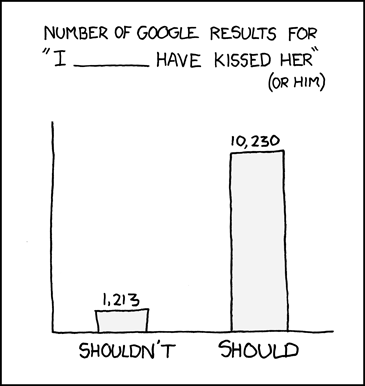
And that's a pretty specific case. I put it to you that the people being quoted here have demostrably failed to take their own advice. Anyone who thinks you never really regret doing things has clearly not done enough foolish and regretable things. I mean, I'm a total square, (no, really), and I haven't done many very exciting or dangerous things; I don't take drugs or smoke or engage in any really particularly reckless behaviours, and even I regret more things I have done than things I haven't. I feel that often I have legitimately tried to do the things I regret not succeeding at, anyway. I feel like I don't know or talk to anough people in my course, and so I gritted my teeth and fair-and-square signed up to learn salsa with them. It didn't work, since apparently so did every other girl in the course, and maybe all of 17 guys, but I gave it a legit shot, so I don't feel the need to beat myself up about it. I sort of regret that I never became a teen star sensation or something (I mean Elijah Wood had already signed up for LOTR when he was 18. I've never been in any movies, let alone record-breaking, blockbusting trilogies which instantly become a major part of the public consciousness) but it's not like that's something I ever actually wanted to do.
I think, in fact, that mainly the things I regret are things I've said. I talk too fast and too much and too often, so I regret a lot of things I've said before thinking. Or at any rate, I have regretted a lot of those things. Frankly, I say instantly regrettable things so often that the sheer volume of them makes it difficult to regret many of them for long.
Back to the kissing graph: you know, the more I think about it, the more silly it seems. Of course you regret not kissing him/her. You never found out how that would've turned out, so in your mind it's Cinderella endings and happily ever after. You don't deal with the possible bad outcomes, so you're free to regret at leisure,happy in the belief that you threw away a perfect future, that that would have been a perfect future. I've had a lot of crushes in my time (a lot) and I've probably wanted to kiss more people than I even remember wanting to kiss, but I don't regret not kissing them. (Maybe I regret that they didn't kiss me, but this is hardly a legitimate regret. That's for them to regret.) Conversely, I did once, long ago, kiss someone I had a crush on and (on the cheek) and it was the most awkward thing ever (despite the cheek-ness! Imagine if it had been a proper kiss! it would have been unbearably mortifying), and I regretted that like anything.
Seriously, who are these people walking around going "if I were to kiss a person we would instantly have a fulfulling romantic experience, because I am just that good, but instead, despite this firm belief, I will not kiss people, but will rather refrain and then tell the internet about how I regret my choices"? Apparently there are more than ten thousand of them!
I was going to write this whole thing about how it would be awesome if you could sell the days of your life that you've totally wasted to old people who would treasure it more (I mean seriously, I don't need today, I barely even took any notes, all I did was fall asleep in lectures and on buses and alternate between being excited and disappointed about dancing, some little old lady who wants to spend just one more day with her grandchildren or whatever could totally have it) but then I realised 3 things: firstly that it's very late, secondly that I've written an awful lot, and thirdly that that is essentially the whole basis of capitalist economy and paid labour. So, having invented the industrial revolution and reframed your boring work day as an opportunity for young-you-now to sell a day of life to old-you-in-the-future (who'll need those wages and savings to buy bingo chips and sherry and so on) (you're welcome), I am going to bed.
After all, although, as Douglas Adams said: "Time is an illusion, lunchtime doubly so", bedtime remains the sort of illusion that I really ought to pay some attention to.
Sunday, May 02, 2010
In Which a blogger returns after an inexplicably weary hiatus
Hey there Cats and Kittens, sorry I haven't updated in ages, I'm not quite sure what the go was, I just sort of suddenly got very very tired. Like, all-of-a-sudden-I-seem-to-need-9.5-hours-sleep-per-night-just-to-function tired, somehow-I-can-barely-move-my-fingers-to-knit-this-stitch tired. Weird. So, I mean, I guess I'm anaemic or have low something or high something, but the upshot was that I couldn't seem to think of anything to write, and when I could it just seemed like an enormous effort even to contemplate actually writing.
It's not that I'm less tired now, it's just that eventually in life you just have to man up and do things. Like study for your Anatomy test on Tuesday. And it is at those times, as you know, that I tend to man up in the slightly misdirected fashion which entails blogging instead.
So, what's new? Nothing much, really, although I note that I rather mysteriously have 2 new "Followers" (creepiest term ever, somehow. Like you guys are stalkers or I'm some kind of crackpot cult messiah. I do not really feel that it reflects awfully well on either of us, Dear Reader. Still, it's flattering). One of whom is a friend of Beloved-by-all Bish and the other of whom has a name I don't recognise. Which is fine.
It's a strange thing, the idea of new people reading this blog, because it seems so varied (from my point of view) that it really seems as if any kind of disembling would be impossible. The shear volume of text is such that a great deal of my self must somehow be revealed to anyone with the enthusiasm to read it all. A lot of it is wildly out of date, of course, and naturally a great amount of it is just so much parenthetical hot air, but I wonder how clear the distinction would be, to the casual reader, between what is relevant and true now, and what was barely right even all those years or months ago when I wrote it half asleep.
At the moment I'm alternating between studying and procrastinating. Other tabs open at the moment are the Anatomy tutorial videos and the 365 Project, which I joined yesterday in a fit of enthusiasm. I'm not sure how that will work out, but it's fun to try these sorts of things, and although a lot of the people seem to be trying to build some kind of photography fan-base, my aim is, as usual, to try and encourage myself to pay more attention to the little things in life which are beautiful or lovely or whatever. There hasn't been much of that so far, because there're only 2 pictures up yet, and both of those are more of a self-introductory sort of variety.
The anatomy video interests me, I am ashamed to say, mainly because the demonstrator is pointing out neural structures on preserved slices of human brain using what very much appears to be a knitting needle. I love that confluence of prosaic, quotidian domestic item, the macabre, and the carefully detatched scientific structure and voice. Although pens are maybe more common, I really don't think anything would accomplish that counterpoint as well as the knitting needle. With it's traditional femininity and its vibe of handcrafts, it's perfect, somehow. Also it's an excellent pointing shape.
Plus, where did it come from? Did someone in the anatomy lab one day say "I'm tired of pointing to things with these wooden pointing sticks we keep in pencil jars here, it's time to upgrade!" and then go to Spotlight to buy them? You can just imagine the guy, having left his lab coat behind and fought his way past the huge rolls of fabric and the shelves of different yarns of different colours, to the knitting needle rack, looking at the different gauges and lengths and varieties, going "Um, well, I guess neural structures probably need about a number 6 size needle, I mean the basal ganglia is pretty delicate. I guess?" Did they just buy 1 pair, or several, assuming that knitting needles, like pens, eventually evaporate in a shared work environment?
Or did someone's wife or girlfriend or flatmate come home one winter evening to discover that her attempt to knit herself (or himself) a scarf and widen their skillset has ground to a halt because the anatomist in their life had wandered off with the needle which happened not to have wool on it? "What a useful stick! I will take this and point to things with it! How useful! I will take this one, because the other person has two, so I'm sure she won't miss the second one." If you had explained that this was a problem to the imaginary anatomist character, would they bring back your needle? If so, could you ever really feel the same way about it, and finish your scarf, knowing that it had been used to casually poke bits of cold wet spinal cord around?
In related news, I have been knitting again myself, because 'tis the season. (Cunningly, I use double-pointed needles which are afixed to one another in a loop, so you can make round things and also anatomists find it harder to make off with half of the pair.) I started making a baby hat for a pregnant school friend (of which I suddenly have 2), but had to restart about 10 times because of trifling errors such as misjoining the original round and thus making mobius strips rather than hats, and similar. As a result I've run out of steam on that project rather, but am confident that will successfully make other things sooner or later.
Isn't that an exciting thing to read about? No? Well, at least I feel like I've broken the ice on the blog again, and will get back to you again, sooner this time, with another post, presumably a less knitting-centred one.
It's not that I'm less tired now, it's just that eventually in life you just have to man up and do things. Like study for your Anatomy test on Tuesday. And it is at those times, as you know, that I tend to man up in the slightly misdirected fashion which entails blogging instead.
So, what's new? Nothing much, really, although I note that I rather mysteriously have 2 new "Followers" (creepiest term ever, somehow. Like you guys are stalkers or I'm some kind of crackpot cult messiah. I do not really feel that it reflects awfully well on either of us, Dear Reader. Still, it's flattering). One of whom is a friend of Beloved-by-all Bish and the other of whom has a name I don't recognise. Which is fine.
It's a strange thing, the idea of new people reading this blog, because it seems so varied (from my point of view) that it really seems as if any kind of disembling would be impossible. The shear volume of text is such that a great deal of my self must somehow be revealed to anyone with the enthusiasm to read it all. A lot of it is wildly out of date, of course, and naturally a great amount of it is just so much parenthetical hot air, but I wonder how clear the distinction would be, to the casual reader, between what is relevant and true now, and what was barely right even all those years or months ago when I wrote it half asleep.
At the moment I'm alternating between studying and procrastinating. Other tabs open at the moment are the Anatomy tutorial videos and the 365 Project, which I joined yesterday in a fit of enthusiasm. I'm not sure how that will work out, but it's fun to try these sorts of things, and although a lot of the people seem to be trying to build some kind of photography fan-base, my aim is, as usual, to try and encourage myself to pay more attention to the little things in life which are beautiful or lovely or whatever. There hasn't been much of that so far, because there're only 2 pictures up yet, and both of those are more of a self-introductory sort of variety.
The anatomy video interests me, I am ashamed to say, mainly because the demonstrator is pointing out neural structures on preserved slices of human brain using what very much appears to be a knitting needle. I love that confluence of prosaic, quotidian domestic item, the macabre, and the carefully detatched scientific structure and voice. Although pens are maybe more common, I really don't think anything would accomplish that counterpoint as well as the knitting needle. With it's traditional femininity and its vibe of handcrafts, it's perfect, somehow. Also it's an excellent pointing shape.
Plus, where did it come from? Did someone in the anatomy lab one day say "I'm tired of pointing to things with these wooden pointing sticks we keep in pencil jars here, it's time to upgrade!" and then go to Spotlight to buy them? You can just imagine the guy, having left his lab coat behind and fought his way past the huge rolls of fabric and the shelves of different yarns of different colours, to the knitting needle rack, looking at the different gauges and lengths and varieties, going "Um, well, I guess neural structures probably need about a number 6 size needle, I mean the basal ganglia is pretty delicate. I guess?" Did they just buy 1 pair, or several, assuming that knitting needles, like pens, eventually evaporate in a shared work environment?
Or did someone's wife or girlfriend or flatmate come home one winter evening to discover that her attempt to knit herself (or himself) a scarf and widen their skillset has ground to a halt because the anatomist in their life had wandered off with the needle which happened not to have wool on it? "What a useful stick! I will take this and point to things with it! How useful! I will take this one, because the other person has two, so I'm sure she won't miss the second one." If you had explained that this was a problem to the imaginary anatomist character, would they bring back your needle? If so, could you ever really feel the same way about it, and finish your scarf, knowing that it had been used to casually poke bits of cold wet spinal cord around?
In related news, I have been knitting again myself, because 'tis the season. (Cunningly, I use double-pointed needles which are afixed to one another in a loop, so you can make round things and also anatomists find it harder to make off with half of the pair.) I started making a baby hat for a pregnant school friend (of which I suddenly have 2), but had to restart about 10 times because of trifling errors such as misjoining the original round and thus making mobius strips rather than hats, and similar. As a result I've run out of steam on that project rather, but am confident that will successfully make other things sooner or later.
Isn't that an exciting thing to read about? No? Well, at least I feel like I've broken the ice on the blog again, and will get back to you again, sooner this time, with another post, presumably a less knitting-centred one.
Tuesday, March 30, 2010
In Which there is published a spurious Dispatch from Poetania: Camisole
Today’s post is dedicated in honour of a friend who is departing for the furthest reaches of the globe (sooner or later; I should probably save this and publish around actual departure time, but I would certainly forget), in fond and inadequate imitation of the blog he had just better continue updating from wherever it is he ends up.
The birds will continue to sing
And indeed,
We should be surprised should they cease.
Life seems unlikely
To alter really radically.
But it will be with a little despondency
That we read your Dispatches.
For although you were rarely there
And when you were, it was late,
The knowledge
That you are not going to guiltily
Melodramatically
Burst in,
Just as the party starts to wind up,
(with stories of the perfidies
of buses and brothers and the BBC)
Will weigh upon our spirits,
Just a little.
And though we deplore them
Though we criticise and plot
To eradicate them while you sleep,
Nonetheless,
We will miss
Your stupid sideburns.
The birds will continue to sing
And indeed,
We should be surprised should they cease.
Life seems unlikely
To alter really radically.
But it will be with a little despondency
That we read your Dispatches.
For although you were rarely there
And when you were, it was late,
The knowledge
That you are not going to guiltily
Melodramatically
Burst in,
Just as the party starts to wind up,
(with stories of the perfidies
of buses and brothers and the BBC)
Will weigh upon our spirits,
Just a little.
And though we deplore them
Though we criticise and plot
To eradicate them while you sleep,
Nonetheless,
We will miss
Your stupid sideburns.
Wednesday, March 24, 2010
In Which a bunch of Fragments are collected
So, I often sort of wonder whether my blog is actually more of a waste of ideas than a discussion of them. I feel like I start off somewhere reasonable like “howzabout those new ads?” or “tropes, man, I mean, eh?” and then I have lots and lots of little ideas, which really could use proper exploring, but which generally just get pelted like hail into the post, and not explored any further. So, I can’t go about the place writing another very similar post about how it is that so many of my friends are geeky and so on, because that one’s used up, but lots of the things I only glancingly mentioned could’ve made quite a good post all by themselves, had I the wherewithal to exploit that. Basically it’s the same problem as I used to have with essays. Fortunately, however, no-one’s marking these posts, so we should be ok.
What makes this seem really especially relevant, though, is that I’ve just found a bunch of half-written, never-posted blog posts saved on my computer. And I would just finished them, polish them up and post them, but I can’t really remember where I was going with them, so here’s my plan: Instead of doing it properly or keeping them languishing forever on my laptop, I’ll just post them as is, caveat emptor as it were. Later on, if I suddenly remember or can be bothered, I might finish some of them and repost them as whole posts, and if so, I’ll signpost that reasonably clearly, so you don’t sit there reading them at work going “this is it; I’ve finally gone mad, and am thinking like Ang, because I swear I’ve read or thought all this before”.
So, here you are, some fragments:
In Which Worth is Mysterious
Where does a person’s worth lie? Traditionally, we have all been taught that it’s all about the heart and mind. A literary hero is someone with extraordinary courage or kindness or something (Brontës excepted, of course), and preferably someone with some kind of combat skills and a way with the ladies. This is an interesting point in the first place: from our earliest youth we are taught that these qualities are heroic and great, and it makes us special that we all have them. Except that if we’re all taught that we have the uniquie quality of being especially lovely, then just exactly how special is it?
I have little direct experience with the social pressures on boys, being as how I’m a girl myself, with no brothers, and who was confined to the exclusively female environment of a girls’ school until uni, more or less. I don’t know how it is that boys become men, since the ones I know tend to be either fully-fledged or sort of permanently half-baked. Obviously, there must be some strange pressures on young men, and presumably these are ongoing in some way, but it would be the height of hypocrisy of me to presume to write about them. Therefore, this post is going to be pretty markedly gendered. If this is something you anticipate finding infuriating, ciao.
I guess the whole crux of what I want to get at here is articulated best by that Disney movie Beauty and The Beast. Either you’ve seen it, or you should, and if the latter, I assume you were raised Amish or something (nice work being online to read blogs, if so). There’s this whole thing about how Belle is smart, and well-read, and also gorgeous. The bad guy, a roguish hunk named Gaston say that she’s “the more beautiful girl in town – that makes her the best!”. You’re supposed, as a child, to sort of boo-hiss at this point, because if Care Bears and Roald Dahl’s Twits have taught us anything, it’s that true beauty is deeper than that. She does happen to be the “best” in town, but actually that’s because of being bookish. Except, they sure did go ahead and make her the most beautiful anyway, just for emphasis. It’s not “Smart Girl and the Beast” or “Chick who Makes Friends with the Anthropomorphised Crockery and the Beast” (either a more accurate summary of the character’s relevant skills). What makes her special is that she looks past the ugliness of the Beast and sees that he’s quite nice really (except that he’s not, at least at first, that’s the whole point). In fact, when he becomes officially nice, he gets to be attractive too (although not as good-looking as Aladdin).
What’s happening here? We go to lengths to teach kids that it doesn’t matter how they look, but there’s already this subtext: a real hero is nice to teapots and looks good flourishing a sword. You can really look up to a man whose teeth go ting in the sunlight.
*****
(Intriguingly, this fragment gets to remarkably closely resemble the other day’s post. Apparently my subconscious has Thoughts about Beauty & The Beast. Probably it’s on account of having accumulated days and days of total viewing time watching it as a child. Well, mainly as a child.)
*****
In Which Writing is just One of Those Things
So, I am chary of apologising for not writing in weeks, ever since that XKCD last week which made us all feel so self-conscious about whether we were, in fact, deeply uninteresting (http://xkcd.com/621/). But nonetheless, I do have a reason for not having posted in a while. Firstly, I’ve been studying for my exams, and thus unwilling to spend my spare time at my computer, and secondly because I sort of got into a bit of a rut with the writing thing, and I didn’t want to just write the same thing over and over again.
I am listening, while ostensibly studying (and I am studying, I have learned all about corticosteroids this afternoon, and learned that I need to start summarising my notes as the semester progresses over the last fortnight) to the Camera Obscura album My Maudlin Career. This hasn’t grown on me so much as some of their earlier stuff, because it turns out that it actually is rather more maudlin than previously. What prompts me to write is the line which was just sung at me “so you think you want to be a writer. A fantastic idea”, and now I’m all contemplative.
I have a friend (a Dad, in fact) who has a theory that being a writer is the only really satisfactory way to become obscenely rich. Like the other ways to get obscenely rich (rather than just Really Quite Comfortably Off) it is highly unreliable, since most writers are more prone to be Struggling Artists. But unlike such things as major scientific advances or Inventions or what have you, there’s no moral murk about getting rich from it. If I invent a fantastic thing which purifies water, say, at practically no cost, and then charge through the nose for it (which is an important step preceding the one labelled “Profit”) then that’s pretty seriously morally suspect. If I come up with a cure for malaria or Cancer or AIDS and charge for it so that only people with money can afford to access it then I am roughly on a par with Hitler in the “Good Citizens of the World” stakes.
BUT... if I write (if one writes, anyway) Harry Potter or something then it’s definitely mine, people don’t need it, so it’s not wrong to withhold it pending payment, but a lot of people do want it, and I’ve made something which wasn’t there before and so on and so on. Obviously, if I write The Da Vinci Code and significantly increase the amount of paranoid stupidity and conspiracy theorising in the world, muddying what little knowledge of history has made it into popular culture, then that’s less than ideal. But something like Harry Potter hasn’t made anyone stupider, surely. I mean, it provoked book burnings and such in the Bible Belt, but they were nutters. Nutters who paid for the copies they flamboyantly flambéed. I mean, those guys probably raised the royalties revenue noticeably. ‘Nuf said about previously existent dimness. There’s no helping that particular demographic.
*****
As to this one, I’d just love to know where I was going with all that, but I probably never will. I mean it definitely looks to be heading towards “so being a writer is the best way of being rich”, but I wonder if it was to end up “maybe I should publish my blog, and make all 4 of you reader types pinky swear to buy a copy and recommend it. I could be like David Sedaris and end up with my own TV show or something!” or on more of a “I wonder how that could even be done, man, that sort of thing takes a lot of perseverance and being good at dealing with rejection, nuts to it”? It could even have been heading “I hope one of you people I know becomes a famous author some day so I can be all ‘I know that guy!’: we’re looking at you, Spencer”-wards, for all I recall.)
*****
In Which a Blogger Gets Away with It
You know something wonderful? It’s nearly the end of August. This means that next Wednesday is my birthday but even more delightful than that is the fact that this means that Spring is on its way. Sure, there’s always a cold snap in September-ish, and it often cools for a while in November or whatever, but it will eventually, inevitably, be warm. In a few meagre months’ time, we will count how long it was since we felt “too cold” (not “deliciously cool” like an evening breeze or a soft-drink being spruiked by a model who would die before drinking it or anything else so sugary) in days. In weeks, even! It the moment, it’s more a “minutes” sort of measure. “Hours” if we’re lucky. But we won’t stand in the shower aware that the hot water can’t last forever but dreading the chill gust of air when we step out onto the bathmat. We may not bounce perkily out of bed of a morning for our 8 am lectures (I personally have a strong moral stance against that sort of behaviour at any time of year) but we won’t lie there with our blankets drawn up to our chins, looking at our jumper,visible from where we lie, but separated from us by aeons of icy transition.
It’s pretty exciting, you guys. Warmth which you don’t have to get out of a kettle via a hot-water-bottle or tea mug.
Anyway, this wasn’t what I was going to talk about so much as something which has just suddenly and excitingly struck me. I was going to talk about “getting away with it”. Maybe this is not something you often think about, it could be that you feel that you are perfectly competent at everything you turn your hand to on a day to day basis. Let me tell you, if you are in fact able to do all the things you’re supposed to be able to do, you’re missing out on a world of adventure.
This is obviously particularly relevant to me in my student capacity. I have a latin major but was sort of surprised to have slipped through the net with every latin exam I failed to fail. In anatomy labs and such, I am constantly surprised by the things that everyone else seems to just know. I don’t remember ever being told what the branches of the trigeminal nerve are, but everyone seems to know them. (I’ve got them now, but the point stands) I’m fairly sure that I get a bigger sense of achievement out of every question correctly answered than other people, just because I’m so surprised that I got away with it. That I guessed right, or managed to pull the answer out of the air (which is often how it feels) – that “holy crap! I knew that! Wow! I should say it again and listen this time, so I can write it down!” feeling.
And it’s not just study things, this is how I know almost all the things I know. It’s ridiculous that I’ll make an obscure reference and then go “tell me you’ve seen that! A Bit of Fry & Laurie! C’mon!” but totally miss quotes from Ace Ventura or whatever it is the kids quote these days. Zoolander? (Actually, I did see Zoolander). It has come to my attention that doing this is about as socially acceptable on a “things that make you a terrible person and conversationalist” scale as just kicking people in the shins when they sass you, so I plan to stop doing it (well, both those things) any time now.
A fortnight ago I managed to conduct an entire conversation with someone about a singer by whom I know a total of 2 songs. The thing is, they happened to be the two songs that the girl I was talking to really liked. So I got away with it. I wasn’t actually pretending to know more than I did, so maybe “got away with it” has a more surreptitious air than it really ought to have done.
The thing is, as I’ve said innumerable times, I know almost nothing about almost everything. The thing is, not-quite-nothing is just enough most of the time. It’s amazing how often I’ll randomly get given one fragment of information or see one episode or something and that will be exactly what’s required that I know the next day. It sort of makes me wonder how many things I’m missing, but mainly it just makes me dangerously cocky.
Because the thing is, if you strike lucky 3 times, people won’t believe you that that’s genuinely all you know about things. Someone will list three books that they’ve read and they’ll merely happen to be three that you’ve also read, or read reviews of, or heard about on the bus, and they will assume you know every other book they ever read.
I failed to get away with it once when someone quoted a Jason Mraz song at me (long ago, before I had ever heard anything other than The Remedy, the one everyone knows) and asked if I knew any of Jason Mraz’s stuff. It’s a funny look you get when, asked about a singer you answer “it’s a familiar name, I think maybe I’ve read some of his stuff”. (Also, oh my, so embarrassing).
But with music in particular this is always happening to me. Music is a little like the Cranial Nerves in this respect; I feel like I managed to miss out on some kind of essential information that everyone else got. I’m just absolutely not in the loop except occasionally by chance. I’ll know the obscure band (by chance) which leads people to assume that I’m down with the scene, and then I’ll be all “The Kinks? Weren’t they on the Juno soundtrack?”.
Essentially that’s the thing, that’s the knack to getting away with these things. It’s exactly like having a towel in the Hitchhiker’s Guide to the Galaxy. If you have one thing (a towel, a working knowledge of String Theory, a recognition of the works of The Kings of Convenience or Darren Hanlon), people will naturally assume that you’ve merely forgotten whatever else is in question and happily lend you the relevant stuff (a toothbrush and place to sleep, Newton’s 3rd Law, or who the hell Deerhunter are).
The funny thing is, I never pretend to know more than I do (not since I wised up at the age of about 13) except in exams, when that’s the whole point. But it’s funny how disconcerting it is when people suddenly realise that you weren’t just being all false-modest and faux-naïf when you said that you didn’t really know anything about this stuff.
*****
So, uh, there you go?
What makes this seem really especially relevant, though, is that I’ve just found a bunch of half-written, never-posted blog posts saved on my computer. And I would just finished them, polish them up and post them, but I can’t really remember where I was going with them, so here’s my plan: Instead of doing it properly or keeping them languishing forever on my laptop, I’ll just post them as is, caveat emptor as it were. Later on, if I suddenly remember or can be bothered, I might finish some of them and repost them as whole posts, and if so, I’ll signpost that reasonably clearly, so you don’t sit there reading them at work going “this is it; I’ve finally gone mad, and am thinking like Ang, because I swear I’ve read or thought all this before”.
So, here you are, some fragments:
In Which Worth is Mysterious
Where does a person’s worth lie? Traditionally, we have all been taught that it’s all about the heart and mind. A literary hero is someone with extraordinary courage or kindness or something (Brontës excepted, of course), and preferably someone with some kind of combat skills and a way with the ladies. This is an interesting point in the first place: from our earliest youth we are taught that these qualities are heroic and great, and it makes us special that we all have them. Except that if we’re all taught that we have the uniquie quality of being especially lovely, then just exactly how special is it?
I have little direct experience with the social pressures on boys, being as how I’m a girl myself, with no brothers, and who was confined to the exclusively female environment of a girls’ school until uni, more or less. I don’t know how it is that boys become men, since the ones I know tend to be either fully-fledged or sort of permanently half-baked. Obviously, there must be some strange pressures on young men, and presumably these are ongoing in some way, but it would be the height of hypocrisy of me to presume to write about them. Therefore, this post is going to be pretty markedly gendered. If this is something you anticipate finding infuriating, ciao.
I guess the whole crux of what I want to get at here is articulated best by that Disney movie Beauty and The Beast. Either you’ve seen it, or you should, and if the latter, I assume you were raised Amish or something (nice work being online to read blogs, if so). There’s this whole thing about how Belle is smart, and well-read, and also gorgeous. The bad guy, a roguish hunk named Gaston say that she’s “the more beautiful girl in town – that makes her the best!”. You’re supposed, as a child, to sort of boo-hiss at this point, because if Care Bears and Roald Dahl’s Twits have taught us anything, it’s that true beauty is deeper than that. She does happen to be the “best” in town, but actually that’s because of being bookish. Except, they sure did go ahead and make her the most beautiful anyway, just for emphasis. It’s not “Smart Girl and the Beast” or “Chick who Makes Friends with the Anthropomorphised Crockery and the Beast” (either a more accurate summary of the character’s relevant skills). What makes her special is that she looks past the ugliness of the Beast and sees that he’s quite nice really (except that he’s not, at least at first, that’s the whole point). In fact, when he becomes officially nice, he gets to be attractive too (although not as good-looking as Aladdin).
What’s happening here? We go to lengths to teach kids that it doesn’t matter how they look, but there’s already this subtext: a real hero is nice to teapots and looks good flourishing a sword. You can really look up to a man whose teeth go ting in the sunlight.
*****
(Intriguingly, this fragment gets to remarkably closely resemble the other day’s post. Apparently my subconscious has Thoughts about Beauty & The Beast. Probably it’s on account of having accumulated days and days of total viewing time watching it as a child. Well, mainly as a child.)
*****
In Which Writing is just One of Those Things
So, I am chary of apologising for not writing in weeks, ever since that XKCD last week which made us all feel so self-conscious about whether we were, in fact, deeply uninteresting (http://xkcd.com/621/). But nonetheless, I do have a reason for not having posted in a while. Firstly, I’ve been studying for my exams, and thus unwilling to spend my spare time at my computer, and secondly because I sort of got into a bit of a rut with the writing thing, and I didn’t want to just write the same thing over and over again.
I am listening, while ostensibly studying (and I am studying, I have learned all about corticosteroids this afternoon, and learned that I need to start summarising my notes as the semester progresses over the last fortnight) to the Camera Obscura album My Maudlin Career. This hasn’t grown on me so much as some of their earlier stuff, because it turns out that it actually is rather more maudlin than previously. What prompts me to write is the line which was just sung at me “so you think you want to be a writer. A fantastic idea”, and now I’m all contemplative.
I have a friend (a Dad, in fact) who has a theory that being a writer is the only really satisfactory way to become obscenely rich. Like the other ways to get obscenely rich (rather than just Really Quite Comfortably Off) it is highly unreliable, since most writers are more prone to be Struggling Artists. But unlike such things as major scientific advances or Inventions or what have you, there’s no moral murk about getting rich from it. If I invent a fantastic thing which purifies water, say, at practically no cost, and then charge through the nose for it (which is an important step preceding the one labelled “Profit”) then that’s pretty seriously morally suspect. If I come up with a cure for malaria or Cancer or AIDS and charge for it so that only people with money can afford to access it then I am roughly on a par with Hitler in the “Good Citizens of the World” stakes.
BUT... if I write (if one writes, anyway) Harry Potter or something then it’s definitely mine, people don’t need it, so it’s not wrong to withhold it pending payment, but a lot of people do want it, and I’ve made something which wasn’t there before and so on and so on. Obviously, if I write The Da Vinci Code and significantly increase the amount of paranoid stupidity and conspiracy theorising in the world, muddying what little knowledge of history has made it into popular culture, then that’s less than ideal. But something like Harry Potter hasn’t made anyone stupider, surely. I mean, it provoked book burnings and such in the Bible Belt, but they were nutters. Nutters who paid for the copies they flamboyantly flambéed. I mean, those guys probably raised the royalties revenue noticeably. ‘Nuf said about previously existent dimness. There’s no helping that particular demographic.
*****
As to this one, I’d just love to know where I was going with all that, but I probably never will. I mean it definitely looks to be heading towards “so being a writer is the best way of being rich”, but I wonder if it was to end up “maybe I should publish my blog, and make all 4 of you reader types pinky swear to buy a copy and recommend it. I could be like David Sedaris and end up with my own TV show or something!” or on more of a “I wonder how that could even be done, man, that sort of thing takes a lot of perseverance and being good at dealing with rejection, nuts to it”? It could even have been heading “I hope one of you people I know becomes a famous author some day so I can be all ‘I know that guy!’: we’re looking at you, Spencer”-wards, for all I recall.)
*****
In Which a Blogger Gets Away with It
You know something wonderful? It’s nearly the end of August. This means that next Wednesday is my birthday but even more delightful than that is the fact that this means that Spring is on its way. Sure, there’s always a cold snap in September-ish, and it often cools for a while in November or whatever, but it will eventually, inevitably, be warm. In a few meagre months’ time, we will count how long it was since we felt “too cold” (not “deliciously cool” like an evening breeze or a soft-drink being spruiked by a model who would die before drinking it or anything else so sugary) in days. In weeks, even! It the moment, it’s more a “minutes” sort of measure. “Hours” if we’re lucky. But we won’t stand in the shower aware that the hot water can’t last forever but dreading the chill gust of air when we step out onto the bathmat. We may not bounce perkily out of bed of a morning for our 8 am lectures (I personally have a strong moral stance against that sort of behaviour at any time of year) but we won’t lie there with our blankets drawn up to our chins, looking at our jumper,visible from where we lie, but separated from us by aeons of icy transition.
It’s pretty exciting, you guys. Warmth which you don’t have to get out of a kettle via a hot-water-bottle or tea mug.
Anyway, this wasn’t what I was going to talk about so much as something which has just suddenly and excitingly struck me. I was going to talk about “getting away with it”. Maybe this is not something you often think about, it could be that you feel that you are perfectly competent at everything you turn your hand to on a day to day basis. Let me tell you, if you are in fact able to do all the things you’re supposed to be able to do, you’re missing out on a world of adventure.
This is obviously particularly relevant to me in my student capacity. I have a latin major but was sort of surprised to have slipped through the net with every latin exam I failed to fail. In anatomy labs and such, I am constantly surprised by the things that everyone else seems to just know. I don’t remember ever being told what the branches of the trigeminal nerve are, but everyone seems to know them. (I’ve got them now, but the point stands) I’m fairly sure that I get a bigger sense of achievement out of every question correctly answered than other people, just because I’m so surprised that I got away with it. That I guessed right, or managed to pull the answer out of the air (which is often how it feels) – that “holy crap! I knew that! Wow! I should say it again and listen this time, so I can write it down!” feeling.
And it’s not just study things, this is how I know almost all the things I know. It’s ridiculous that I’ll make an obscure reference and then go “tell me you’ve seen that! A Bit of Fry & Laurie! C’mon!” but totally miss quotes from Ace Ventura or whatever it is the kids quote these days. Zoolander? (Actually, I did see Zoolander). It has come to my attention that doing this is about as socially acceptable on a “things that make you a terrible person and conversationalist” scale as just kicking people in the shins when they sass you, so I plan to stop doing it (well, both those things) any time now.
A fortnight ago I managed to conduct an entire conversation with someone about a singer by whom I know a total of 2 songs. The thing is, they happened to be the two songs that the girl I was talking to really liked. So I got away with it. I wasn’t actually pretending to know more than I did, so maybe “got away with it” has a more surreptitious air than it really ought to have done.
The thing is, as I’ve said innumerable times, I know almost nothing about almost everything. The thing is, not-quite-nothing is just enough most of the time. It’s amazing how often I’ll randomly get given one fragment of information or see one episode or something and that will be exactly what’s required that I know the next day. It sort of makes me wonder how many things I’m missing, but mainly it just makes me dangerously cocky.
Because the thing is, if you strike lucky 3 times, people won’t believe you that that’s genuinely all you know about things. Someone will list three books that they’ve read and they’ll merely happen to be three that you’ve also read, or read reviews of, or heard about on the bus, and they will assume you know every other book they ever read.
I failed to get away with it once when someone quoted a Jason Mraz song at me (long ago, before I had ever heard anything other than The Remedy, the one everyone knows) and asked if I knew any of Jason Mraz’s stuff. It’s a funny look you get when, asked about a singer you answer “it’s a familiar name, I think maybe I’ve read some of his stuff”. (Also, oh my, so embarrassing).
But with music in particular this is always happening to me. Music is a little like the Cranial Nerves in this respect; I feel like I managed to miss out on some kind of essential information that everyone else got. I’m just absolutely not in the loop except occasionally by chance. I’ll know the obscure band (by chance) which leads people to assume that I’m down with the scene, and then I’ll be all “The Kinks? Weren’t they on the Juno soundtrack?”.
Essentially that’s the thing, that’s the knack to getting away with these things. It’s exactly like having a towel in the Hitchhiker’s Guide to the Galaxy. If you have one thing (a towel, a working knowledge of String Theory, a recognition of the works of The Kings of Convenience or Darren Hanlon), people will naturally assume that you’ve merely forgotten whatever else is in question and happily lend you the relevant stuff (a toothbrush and place to sleep, Newton’s 3rd Law, or who the hell Deerhunter are).
The funny thing is, I never pretend to know more than I do (not since I wised up at the age of about 13) except in exams, when that’s the whole point. But it’s funny how disconcerting it is when people suddenly realise that you weren’t just being all false-modest and faux-naïf when you said that you didn’t really know anything about this stuff.
*****
So, uh, there you go?
In Which the gathering Dark presages, presumably, more thoroughly gathered dark
You guys, when I got up this morning, it was dark. Not that grey insipid morning light which one greets with resignation of a morning toward the end of summer, knowing what it inevitably heralds, but full on, have-I-accidentally-set-my-alarm-to-go-off-in-the-middle-of-the-night-because-it-is-clearly-still-the-middle-of-the-night dark. This is not something which I relish. I like the cold, I do. I like winter. I like rugging up, I like skiing, I like scarves and cups of tea and jumpers and ugg boots (in their place). But there are two things about the coming time of year that I do not like even at all. I do not like getting up in the dark, and I do not like being too cold.
Not ‘too cold’ in the sense of “ooh, it’s not too cold today” in the same way you might describe something of particular niftiness as being “not too shabby” (assuming you’re Australian, of course, I don’t know if the English do this, but I suspect that they do, although presumably less so. Surely no other country can have embraced “average” as in “it’s a bit average” as its highest term of censure. This confuses me every time, and I managed to survive the era of “bad”-means-good), but too cold in that seeping, creeping way, where sitting at your desk leaves you convinced that you’ll just never be quite warm enough for comfort ever again. The kind of too cold where all the sensory input you receive from your extremities is discomfort, and where even a nice-warming-shower or nice-warm-bed has dangerous cold zones so that if you stand or lie in anything but the precisely right space, one bit or other of you becomes frustratingly chilled.
It’s not so bad, really. I mean, I was getting up for a fun reason today, and I didn’t even wear my cardigan most of the day, and I’m sitting here in the quite pleasant breeze as I type this, with no particular urge to shut the window. But it’s the ominousness that gets me. The awareness that if I decide not to ride my bike to uni tomorrow merely on the grounds that it’ll be close to dark by the time I get home, then that’s admitting defeat for a good eight or nine months. The inevitability of it getting much worse before long.
Not even that would be so bad, really, it’s just that I was foolish enough to read a book on the bus for a couple of blocks on the way home, which meant that I arrived home feeling miserably motion-sick, in the dark. There’s something particular about our bus route, I think. I never get motion sick usually, which is why I routinely forget and accidentally read on the bus, but I think that there’s something somehow terribly visceral about the sequence of turns and hills and swinging curves that are dreadfully unkind to the unwary reader. Plus the home-in-the-dark thing. I get used to that pretty quickly, and it doesn’t bother me nearly as much as leaving home in the dark, but at the end of summer I always sort of feel that if I’m going to be getting home after dark, I’d better have had a jolly good evening already.
At this point it becomes very obvious that my idle fantasies of how nice it would be to live in England or Europe and all that are based on the most profound lack of understanding of my own limitations, especially with regard to this issue, on reflection. Still, it’d be a good place to go for a bit of nice subdued summer during a winter, at least. They have buttercups, and downs, and robins which are a good honest red, there. It’s sort of the promised land, really, so long as you’ve been deriving your land-based promises from a very specific subgenre of literature. Not the Arabian Nights, for instance.
In completely unrelated news, though, I’ve just come across a sort of half blog post I must’ve written late last year, and which has, in the intervening months, lost all currency. Nonetheless, I append it herewith, just in case you really have absolutely nothing to do with your afternoon.
A couple of times in the past month I’ve made Facebook status updates about language usage. Because, y’know, I’m a bit of a pedantic dweeb. Amusingly, these have both caused a flurry of comments, with friends weighing in strongly for or against a prescriptivist view of language or whatever (usually “for”, with reservations, because that’s the sort of person with whom I tend to make friends. The kind of people who use the word “whom”, or at least know about it.) It’s funny, even just thinking about these things makes me self-conscious about my sentence structure. Oh no! I can’t end a sentence with a preposition! Not in the middle of a discussion of prescriptivist language! Such tragic irony! And so on. (Although this is one of the few rules of grammar which I think may be bollocks, at least I know about it. I just don’t think it’s necessarily worth bothering with.)
The thing is, it’s all very well to say that it doesn’t matter how you spell things or how you structure your grammar, provided you convey the spirit of the meaning, but it’s just not true. If the internet age has taught us nothing else (apart from “cats, man, what a laugh!”) it’s that text inadequately conveys tone and inflection, and that can be bad. Fortunately, we have punctuation for that. Or at least, for a lot of that (I mean, there’s at least one facebook group about the difference between “Let’s eat, Grandma!” and “Let’s eat Grandma!”). Without it, so little of what we mean can be known for sure (inasmuch as anything can be, in this postmodern blah blah blah). This is mainly a problem because we also live in an age of giant advertising and fine print.
Since so much of what is said has no objective meaning, false advertising suddenly stops being a worry for advertisers. Some chicken fast-food joint, for instance, is currently advertising a range of what I understand are basically milkshakes. (Which seems like a distressing juxtaposition to me, but that’s by the by) The slogans all over buses read proudly “full of real bitz!” That means absolutely nothing. Like, not anything at all. That space would equally well say “words about the drink!” for all the accountability in it.
First up, “Bitz” with a z. That’s not a word, so they don’t have to be full of real anything in particular. Secondly, even if we’re charitable and pretend to believe that “bitz” means “bits”, that still means nothing unless you say what they’re bits of. Full of real bits of bark/person/rock/paper/drink; what? Thirdly, we are earnestly assured that the “bitz” are “real”. Are we all on the same page, here? Bitz is not some desirable brand name that we would fear being given counterfeit versions of, as the ad implies. The other sense of “real”, i.e., “genuinely existent” is surely a given. “Full of imaginary bitz” is presumably the opposite, unless it’s “full of fake bitz”. The only words that have any meaning here are the “full of”, and they’re wrong, since the drink is not “full” of the blasted things anyway.
I realise that maybe I’m overthinking this, but how do these people get away with this sort of crap, with excitedly telling us nothing, and spelling words with a Z for no good reason at all? I can’t think of a single non-suspicious reason a company would have for misspelling a word in it’s advertising in that deliberate sort of way. It can only be because the word which means something is unavailable to them, or because they’re patronisingly trying to connect with some imaginary young-and-dumb demographic.
Similarly, I am suspicious of “natural ingredients” in products. I’m pretty much unconvinced by the idea that the word “natural” has any meaning at all, much. Even if it did, the artificial thing isn’t necessarily worse. Lots of synthetic things are structurally analogous to naturally occurring things, just built so as to have less side-effects or whatever. Snake venom is natural. Refined penicillin is artificial. And so on. And not all the Vitamin E in the world, be it natural, artificial, or occultly unnatural, is going to make you look ten years younger when you rub it on your face.
{So there you have it: present me has mixed feelings about Autumn, and past me felt that KFC was suspect. Good to have that established, isn’t it?}
Not ‘too cold’ in the sense of “ooh, it’s not too cold today” in the same way you might describe something of particular niftiness as being “not too shabby” (assuming you’re Australian, of course, I don’t know if the English do this, but I suspect that they do, although presumably less so. Surely no other country can have embraced “average” as in “it’s a bit average” as its highest term of censure. This confuses me every time, and I managed to survive the era of “bad”-means-good), but too cold in that seeping, creeping way, where sitting at your desk leaves you convinced that you’ll just never be quite warm enough for comfort ever again. The kind of too cold where all the sensory input you receive from your extremities is discomfort, and where even a nice-warming-shower or nice-warm-bed has dangerous cold zones so that if you stand or lie in anything but the precisely right space, one bit or other of you becomes frustratingly chilled.
It’s not so bad, really. I mean, I was getting up for a fun reason today, and I didn’t even wear my cardigan most of the day, and I’m sitting here in the quite pleasant breeze as I type this, with no particular urge to shut the window. But it’s the ominousness that gets me. The awareness that if I decide not to ride my bike to uni tomorrow merely on the grounds that it’ll be close to dark by the time I get home, then that’s admitting defeat for a good eight or nine months. The inevitability of it getting much worse before long.
Not even that would be so bad, really, it’s just that I was foolish enough to read a book on the bus for a couple of blocks on the way home, which meant that I arrived home feeling miserably motion-sick, in the dark. There’s something particular about our bus route, I think. I never get motion sick usually, which is why I routinely forget and accidentally read on the bus, but I think that there’s something somehow terribly visceral about the sequence of turns and hills and swinging curves that are dreadfully unkind to the unwary reader. Plus the home-in-the-dark thing. I get used to that pretty quickly, and it doesn’t bother me nearly as much as leaving home in the dark, but at the end of summer I always sort of feel that if I’m going to be getting home after dark, I’d better have had a jolly good evening already.
At this point it becomes very obvious that my idle fantasies of how nice it would be to live in England or Europe and all that are based on the most profound lack of understanding of my own limitations, especially with regard to this issue, on reflection. Still, it’d be a good place to go for a bit of nice subdued summer during a winter, at least. They have buttercups, and downs, and robins which are a good honest red, there. It’s sort of the promised land, really, so long as you’ve been deriving your land-based promises from a very specific subgenre of literature. Not the Arabian Nights, for instance.
In completely unrelated news, though, I’ve just come across a sort of half blog post I must’ve written late last year, and which has, in the intervening months, lost all currency. Nonetheless, I append it herewith, just in case you really have absolutely nothing to do with your afternoon.
A couple of times in the past month I’ve made Facebook status updates about language usage. Because, y’know, I’m a bit of a pedantic dweeb. Amusingly, these have both caused a flurry of comments, with friends weighing in strongly for or against a prescriptivist view of language or whatever (usually “for”, with reservations, because that’s the sort of person with whom I tend to make friends. The kind of people who use the word “whom”, or at least know about it.) It’s funny, even just thinking about these things makes me self-conscious about my sentence structure. Oh no! I can’t end a sentence with a preposition! Not in the middle of a discussion of prescriptivist language! Such tragic irony! And so on. (Although this is one of the few rules of grammar which I think may be bollocks, at least I know about it. I just don’t think it’s necessarily worth bothering with.)
The thing is, it’s all very well to say that it doesn’t matter how you spell things or how you structure your grammar, provided you convey the spirit of the meaning, but it’s just not true. If the internet age has taught us nothing else (apart from “cats, man, what a laugh!”) it’s that text inadequately conveys tone and inflection, and that can be bad. Fortunately, we have punctuation for that. Or at least, for a lot of that (I mean, there’s at least one facebook group about the difference between “Let’s eat, Grandma!” and “Let’s eat Grandma!”). Without it, so little of what we mean can be known for sure (inasmuch as anything can be, in this postmodern blah blah blah). This is mainly a problem because we also live in an age of giant advertising and fine print.
Since so much of what is said has no objective meaning, false advertising suddenly stops being a worry for advertisers. Some chicken fast-food joint, for instance, is currently advertising a range of what I understand are basically milkshakes. (Which seems like a distressing juxtaposition to me, but that’s by the by) The slogans all over buses read proudly “full of real bitz!” That means absolutely nothing. Like, not anything at all. That space would equally well say “words about the drink!” for all the accountability in it.
First up, “Bitz” with a z. That’s not a word, so they don’t have to be full of real anything in particular. Secondly, even if we’re charitable and pretend to believe that “bitz” means “bits”, that still means nothing unless you say what they’re bits of. Full of real bits of bark/person/rock/paper/drink; what? Thirdly, we are earnestly assured that the “bitz” are “real”. Are we all on the same page, here? Bitz is not some desirable brand name that we would fear being given counterfeit versions of, as the ad implies. The other sense of “real”, i.e., “genuinely existent” is surely a given. “Full of imaginary bitz” is presumably the opposite, unless it’s “full of fake bitz”. The only words that have any meaning here are the “full of”, and they’re wrong, since the drink is not “full” of the blasted things anyway.
I realise that maybe I’m overthinking this, but how do these people get away with this sort of crap, with excitedly telling us nothing, and spelling words with a Z for no good reason at all? I can’t think of a single non-suspicious reason a company would have for misspelling a word in it’s advertising in that deliberate sort of way. It can only be because the word which means something is unavailable to them, or because they’re patronisingly trying to connect with some imaginary young-and-dumb demographic.
Similarly, I am suspicious of “natural ingredients” in products. I’m pretty much unconvinced by the idea that the word “natural” has any meaning at all, much. Even if it did, the artificial thing isn’t necessarily worse. Lots of synthetic things are structurally analogous to naturally occurring things, just built so as to have less side-effects or whatever. Snake venom is natural. Refined penicillin is artificial. And so on. And not all the Vitamin E in the world, be it natural, artificial, or occultly unnatural, is going to make you look ten years younger when you rub it on your face.
{So there you have it: present me has mixed feelings about Autumn, and past me felt that KFC was suspect. Good to have that established, isn’t it?}
Tuesday, March 23, 2010
In Which Tropes are rather hard on Blondes (pun removed due to poor taste)
I watched something the other day which drew my attention to a rather distressing trope. (I won’t tell you what it was in case it spoils it, but obviously it could’ve been practically anything except Sabrina the Teenage Witch and Archie, for which the only difference is a hair colour reversal). It’s something I’ve noticed before in all sorts of movies and books and Broadway shows and whatnot, but it struck me afresh over the weekend as being just a smidgin reprehensible.
The story, in its simplest form, goes like this: the audience is introduced to three people (either a trio of friends or a dude and two ladies who interact exclusively as rivals), a dude (whom we’ll call Dude), and blonde, and a brunette (hereinafter known as Blonde and Brunette, respectively). Both ladies dig Dude, and he dithers (sometimes for series after series) before choosing the Blonde. Later, he leaves Blonde for Brunette, whom he has always known, in his heart of hearts, is his True Love, and the two of them live happily ever after.
Taking the obvious issues in order, more or less, we begin with the Choice, which we might also view as being essential to the characterisation. A choice between a Blonde and a Brunette is always presented as Style versus Substance. Redheads are rare, since the hair colour is crucial, but if they’re around at all, it’s odds-on that they’ll be in some way “fiery”. Blondes are a bit silly or flighty, shallow, either mean or just stupid, and are generally held to be the “cheaper” choice. It’s easy to want a beautiful Blonde, but they’re either shrewish or just generally lacking in Worth, is the point here. Conversely, the bookish, funny (or more often “funny”) Brunette is sweet and patient and good and smart and very probably talks to puppies and kittens and what have you, but she’s not really that attractive, due to her serious lack of blondeness. She always likes the Dude’s pet, if he has one, or Interest if he has one of those instead. The Blonde, naturally, abominates these things, considering them smelly or silly or just generally annoying (depending on whether it’s a dog or white water rafting or weak puns).
Speaking (well, typing) as a flighty brunette who’s allergic to cats, I’ve always felt that there was some considerable undue pressure happening here. Clearly, though, it’s worse for blondes, and I’ve known several blondes dye their hair to escape this whole business, or else somehow tragically internalise the message, convince themselves that they really are somehow cheap, and that whatever Dude is in their life is just constantly waiting to abandon them for a smarter, secretly-prettier (lurking, traditionally, behind glasses, a ponytail, and in extreme cases, unattractive but easily fixed eyebrows) generally Higher Quality Brunette. That’s... that’s pretty bad, you guys. Plus, I’m pretty sure that this caused actual problems in my childhood: I was (and am, obviously) a brunette and my little sister was a blonde, when we were children, and people were always treating us as a smart one and a beautiful one (not my family, though, naturally, because of how they’re really pretty great), which I’m sure must’ve had weird impacts on our interactions and sibling rivalry and stuff. Plus, she’s grown up to have brown hair, so where does that leave her, trope-wise? Honestly, if I were a Blonde, I’d be pretty pissed about this sort of thing.
Next, we have the “choice”. That’s less problematic, but it’s still a bit weird. Have you ever really seen a situation where a guy had an actual “choice” between two girls, as if they were two canapés on a platter being handed out by obsequious waitstaff at some function or other? As if all he had to do was choose between the vol-au-vent and the little skewer? As if he was the only person who had any volition? I mean, this is a pretty common thing, what if this is being internalised by dudes and Dudes everywhere, and they come to actually think that way? What’s even going on there? Is it that the people who wrote this sort of thing originally had never ever been rejected by a lady whom they “chose”, so that it didn’t occur to them that it could happen? Or is it that they were rejected so consistently (especially, presumably, by ladies privy to their scripts-in-progress) that they needed to imagine the sort of world where two whole chicks at once might really dig them? Don’t get me wrong, I’m sure it happens, although I’ve never seen a real example. I mean, shear statistics says that there must sometimes be two people digging the same third person at exactly the same time. But even then, surely it’s weird to have a set-up like this. Those two people are going to be a “good” and “bad” choice pretty rarely, surely?
The way it’s set up is handy for the Dude, though, who never seems to have thought his choice through thoroughly in the first place. Also, mysteriously, unlike every other major choice made in such movies (where the difference between a Coke and a Strawberry Milkshke can be portrayed as being so telling as to make every snack fraught) his decision to go with the beautiful but vapid option does not apparently reflect on his character at all. He hasn’t chosen Blonde because of being a shallow jerk who just wants to get laid, it’s because of Feminine Wiles or something. When he inevitably breaks up with the Blonde for the Brunette, this always seems to work out too. Regarding which: as if. If the girls are set up as friends in the first place, then the Blonde always just has to lump it, with no right to be peeved for more than just a scene. If she’s lucky she’ll get an explanation along the lines of “it wasn’t like that”, but that’s usually it.
The Brunette is even more complicated here. First of all, despite being good and decent and funny/smart, she sees no apparent problem with hijacking her best friend’s boyfriend (and they’re never just sort-of-friends, either; if it’s not full-on cheerleader/nerd rivalry, then they’re bosom buddies who’re going to have to resolve their BFF situation before the end of the film, usually by means of the Blonde just “getting over it”, as if the Brunette was perfectly in the clear, morally, and the Blonde should stop kicking up such a fuss and learn to accept that she’s not really good enough). Secondly, and really this has always seemed stranger to me, Brunette has no problem with someone who, having had the free choice between her and someone else, didn’t pick her. Because she wasn’t the “beautiful” one, or whatever.
Really? Have you ever known a chick like that? One who wouldn’t then spend the rest of the story secretly angsting about what it was about her that made her so much less pretty? One who wouldn’t be in the least fazed by the fact that this allegedly perfect dude, given the choice between what’s set up as Cheap Tackiness and Real Quality, picks the former first? What sort of women are these? Do you reckon any of them have equally gullible and un-shakeable hot brothers, who might like to be chosen between? Because I would way rather be the Dude(tte) in this scenario than either of these strangely over-focussed women.
At this point it strikes me as being necessary to state again that I’m ranting about a fiction trope here. I’ve had many reasonably close male friends date blonde girls, and I would hate any of them to think that I thought them cheap or arrogant, or that I was pining for them, or any of those things. That would be really quite unthinkably frightful. (Especially since, whoa, the more I think about it, the more I realise that there must’ve been nigh on ten such couples with whom I’ve been friends. I can only imagine the sort of awkwardness which would be unleashed if everyone went about trying to find poorly-hidden meaning in my blog).
In fact, there’s really only one weirdness left to point out. In one particularly notable example, which featured Uma Thurman as Blonde, some reasonably attractive young man with a British accent as Dude, and Janeane Should-Seriously-Know-Better Garofalo as Brunette, one of the scenes toward the end has a weirdly telling bit of dialogue. Dude speaks to the chicks and says something like “You’re beautiful and dumb, and you’re brilliant and...” whereupon he trails of significantly. As if (leaving aside the fact that I’ve never noticed Janeane Garofalo being unattractive) saying that a girl is unattractive is somehow so much worse than saying that she’s dumb that even in the heat of his anger, no gentleman could ever do so. Don’t get me wrong, I’d be a long way from relishing feedback like that myself, but seriously? We should both, at the same time, admit to ourselves that we’re better off being unattractive and clever than vice versa, and also agree that it’s ok to slight a girl’s intelligence but never, ever, her looks? What the hell is that? How 1950s do we need to be? This isn’t just that movie, the same thing is implied in every “the brunette becomes beautiful so it’s ok to find her attractive really” scenes since well before The Breakfast Club to well after She’s All That. If attractiveness really isn’t important, why is it a Beauty in Beauty and the Beast rather than just Nice Girl and the Beast (alliteration is not the answer, I’m pretty sure it’s originally French, that story)? This trope wants to have it both ways: unattractive Brunettes are better than shallowly pretty Blondes, but only if they’re still pretty bangin’. You don’t cast Rachel Leigh Cook or Anne Hathaway if you’re really talking about Plain Janes. For all it’s distressing I-won’t-say-such-a-terrible-thing posturing, at least the Truth about Cats and Dogs didn’t add bonus points to the Quality Brunette to make her more appealing (as far as I remember? I’m beginning to worry about this too). That’s just cheating on what’s already a pretty dodgy basic message.
The story, in its simplest form, goes like this: the audience is introduced to three people (either a trio of friends or a dude and two ladies who interact exclusively as rivals), a dude (whom we’ll call Dude), and blonde, and a brunette (hereinafter known as Blonde and Brunette, respectively). Both ladies dig Dude, and he dithers (sometimes for series after series) before choosing the Blonde. Later, he leaves Blonde for Brunette, whom he has always known, in his heart of hearts, is his True Love, and the two of them live happily ever after.
Taking the obvious issues in order, more or less, we begin with the Choice, which we might also view as being essential to the characterisation. A choice between a Blonde and a Brunette is always presented as Style versus Substance. Redheads are rare, since the hair colour is crucial, but if they’re around at all, it’s odds-on that they’ll be in some way “fiery”. Blondes are a bit silly or flighty, shallow, either mean or just stupid, and are generally held to be the “cheaper” choice. It’s easy to want a beautiful Blonde, but they’re either shrewish or just generally lacking in Worth, is the point here. Conversely, the bookish, funny (or more often “funny”) Brunette is sweet and patient and good and smart and very probably talks to puppies and kittens and what have you, but she’s not really that attractive, due to her serious lack of blondeness. She always likes the Dude’s pet, if he has one, or Interest if he has one of those instead. The Blonde, naturally, abominates these things, considering them smelly or silly or just generally annoying (depending on whether it’s a dog or white water rafting or weak puns).
Speaking (well, typing) as a flighty brunette who’s allergic to cats, I’ve always felt that there was some considerable undue pressure happening here. Clearly, though, it’s worse for blondes, and I’ve known several blondes dye their hair to escape this whole business, or else somehow tragically internalise the message, convince themselves that they really are somehow cheap, and that whatever Dude is in their life is just constantly waiting to abandon them for a smarter, secretly-prettier (lurking, traditionally, behind glasses, a ponytail, and in extreme cases, unattractive but easily fixed eyebrows) generally Higher Quality Brunette. That’s... that’s pretty bad, you guys. Plus, I’m pretty sure that this caused actual problems in my childhood: I was (and am, obviously) a brunette and my little sister was a blonde, when we were children, and people were always treating us as a smart one and a beautiful one (not my family, though, naturally, because of how they’re really pretty great), which I’m sure must’ve had weird impacts on our interactions and sibling rivalry and stuff. Plus, she’s grown up to have brown hair, so where does that leave her, trope-wise? Honestly, if I were a Blonde, I’d be pretty pissed about this sort of thing.
Next, we have the “choice”. That’s less problematic, but it’s still a bit weird. Have you ever really seen a situation where a guy had an actual “choice” between two girls, as if they were two canapés on a platter being handed out by obsequious waitstaff at some function or other? As if all he had to do was choose between the vol-au-vent and the little skewer? As if he was the only person who had any volition? I mean, this is a pretty common thing, what if this is being internalised by dudes and Dudes everywhere, and they come to actually think that way? What’s even going on there? Is it that the people who wrote this sort of thing originally had never ever been rejected by a lady whom they “chose”, so that it didn’t occur to them that it could happen? Or is it that they were rejected so consistently (especially, presumably, by ladies privy to their scripts-in-progress) that they needed to imagine the sort of world where two whole chicks at once might really dig them? Don’t get me wrong, I’m sure it happens, although I’ve never seen a real example. I mean, shear statistics says that there must sometimes be two people digging the same third person at exactly the same time. But even then, surely it’s weird to have a set-up like this. Those two people are going to be a “good” and “bad” choice pretty rarely, surely?
The way it’s set up is handy for the Dude, though, who never seems to have thought his choice through thoroughly in the first place. Also, mysteriously, unlike every other major choice made in such movies (where the difference between a Coke and a Strawberry Milkshke can be portrayed as being so telling as to make every snack fraught) his decision to go with the beautiful but vapid option does not apparently reflect on his character at all. He hasn’t chosen Blonde because of being a shallow jerk who just wants to get laid, it’s because of Feminine Wiles or something. When he inevitably breaks up with the Blonde for the Brunette, this always seems to work out too. Regarding which: as if. If the girls are set up as friends in the first place, then the Blonde always just has to lump it, with no right to be peeved for more than just a scene. If she’s lucky she’ll get an explanation along the lines of “it wasn’t like that”, but that’s usually it.
The Brunette is even more complicated here. First of all, despite being good and decent and funny/smart, she sees no apparent problem with hijacking her best friend’s boyfriend (and they’re never just sort-of-friends, either; if it’s not full-on cheerleader/nerd rivalry, then they’re bosom buddies who’re going to have to resolve their BFF situation before the end of the film, usually by means of the Blonde just “getting over it”, as if the Brunette was perfectly in the clear, morally, and the Blonde should stop kicking up such a fuss and learn to accept that she’s not really good enough). Secondly, and really this has always seemed stranger to me, Brunette has no problem with someone who, having had the free choice between her and someone else, didn’t pick her. Because she wasn’t the “beautiful” one, or whatever.
Really? Have you ever known a chick like that? One who wouldn’t then spend the rest of the story secretly angsting about what it was about her that made her so much less pretty? One who wouldn’t be in the least fazed by the fact that this allegedly perfect dude, given the choice between what’s set up as Cheap Tackiness and Real Quality, picks the former first? What sort of women are these? Do you reckon any of them have equally gullible and un-shakeable hot brothers, who might like to be chosen between? Because I would way rather be the Dude(tte) in this scenario than either of these strangely over-focussed women.
At this point it strikes me as being necessary to state again that I’m ranting about a fiction trope here. I’ve had many reasonably close male friends date blonde girls, and I would hate any of them to think that I thought them cheap or arrogant, or that I was pining for them, or any of those things. That would be really quite unthinkably frightful. (Especially since, whoa, the more I think about it, the more I realise that there must’ve been nigh on ten such couples with whom I’ve been friends. I can only imagine the sort of awkwardness which would be unleashed if everyone went about trying to find poorly-hidden meaning in my blog).
In fact, there’s really only one weirdness left to point out. In one particularly notable example, which featured Uma Thurman as Blonde, some reasonably attractive young man with a British accent as Dude, and Janeane Should-Seriously-Know-Better Garofalo as Brunette, one of the scenes toward the end has a weirdly telling bit of dialogue. Dude speaks to the chicks and says something like “You’re beautiful and dumb, and you’re brilliant and...” whereupon he trails of significantly. As if (leaving aside the fact that I’ve never noticed Janeane Garofalo being unattractive) saying that a girl is unattractive is somehow so much worse than saying that she’s dumb that even in the heat of his anger, no gentleman could ever do so. Don’t get me wrong, I’d be a long way from relishing feedback like that myself, but seriously? We should both, at the same time, admit to ourselves that we’re better off being unattractive and clever than vice versa, and also agree that it’s ok to slight a girl’s intelligence but never, ever, her looks? What the hell is that? How 1950s do we need to be? This isn’t just that movie, the same thing is implied in every “the brunette becomes beautiful so it’s ok to find her attractive really” scenes since well before The Breakfast Club to well after She’s All That. If attractiveness really isn’t important, why is it a Beauty in Beauty and the Beast rather than just Nice Girl and the Beast (alliteration is not the answer, I’m pretty sure it’s originally French, that story)? This trope wants to have it both ways: unattractive Brunettes are better than shallowly pretty Blondes, but only if they’re still pretty bangin’. You don’t cast Rachel Leigh Cook or Anne Hathaway if you’re really talking about Plain Janes. For all it’s distressing I-won’t-say-such-a-terrible-thing posturing, at least the Truth about Cats and Dogs didn’t add bonus points to the Quality Brunette to make her more appealing (as far as I remember? I’m beginning to worry about this too). That’s just cheating on what’s already a pretty dodgy basic message.
Thursday, March 18, 2010
In Which Size is Power and Tim Burton is less than wholly Compelling (here be spoilers)
It may be that this whole blog thing is getting out of hand. I suspect this on the grounds that this evening I went and watched Alice in Wonderland Tim Burton style, and really didn't focus. This is not just because I've read a number of reviews of varying degrees of pithiness written by my eloquent and well-read friends and acquaintances (which were much more interesting and thus intrusive to my viewing than the professional reviews which were all "that Mia girl is so hot right now" and "Oh Tim Burton, you wacky aesthete you" rather than "dude totally misquoted the Jabberwocky poem", "you call that consistent imagery and characterisation, do you?" and "Tim Burton is to Alice in Wonderland as 5ive is to We Will Rock You".) Mainly it was because I was sitting there acting like some terrible combination of an Arts Grad who takes themselves too seriously, a Year 12 English student and an early xkcd comic; intead of trying to immerse myself in the film, I was contemplating a blog post discussing the interface between size and power.
Basically - and Spoiler Alert, dudes and dudettes (or at least, for those of you who have never engaged with the Alice in Wonderland story in any way, there will be big spoilers, and if you haven't seen the movie then sort of moderate spoilers, but as if this platter of aesthetic indulgence is "spoilable", it's totally one of those journey-not-the-destination things) - Alice has to fight any number of oppressive forces, most relevantly a huge dragon thing, as well as an evil monarch who is self-concious about her unusual appearance. Fine. Also Alice repeatedly solves things in the "problem solving" type areas of her adventure by getting a bunch bigger or smaller. This is apparently perfectly normal in Wonderland, where people always seem to have the relevant potions or whatever handy, although no-one else actually uses any at any time.
But at no point does anyone, either Alice or any of the other characters, just go "sod this for a game of soldiers; I'm going to eat enough cake to be a total giant (while keeping the shrinking potion on hand to avoid plot devices) and just step on the damn Jabberwocky beast thing". Or even just evade capture or prison by growing or shrinking. The Hatter sits in prison and is all "it sure is a pity that I'm manacled and behind bars and doomed to be executed" even though we know that he had become-tiny-juice in his pocket (or on his person) 10 scenes ago, and that he was arrested in the same clothes as he was wearing when he had it last. And he never goes, "man, bugger it, I'm going to become tiny and escape, and enormous if I'm attacked".
Why is this? Is it because once anyone starts messing about like that, all bets are off? Like all the inhabitants of Wonderland have a Gentlemen's Agreement not to start down the road of getting enormous and trying to step on one another, on the grounds that the consequent oneupmanship would cause irreparable damage to the infrastructure? If so, are the potions they all have on hand just for defusing emergencies, like an OH&S sort of thing? Why else would a 2 foot rabbit in a page's uniform be carrying an untouched piece of become-large cake with him, despite maintaining a completely constant size for the whole time?
Size is Power. All you have to do is get bigger or smaller, and everything can be solved. Or could be, if they just, you know, ate cake or drank apparently-gross-tasting fluids made of unspeakble ingredients. Maybe it's all just an elaborate metaphor? Like cake makes people bigger and detox diets and wierd laxatives make them smaller in the world Tim Burton actually inhabits. Because obviously size is power in real life. Cosmopolitan sells millions of copies around the world every month (caution: statistics may not be to scale. Who the hell knows how many Cosmos they sell? I assume millions. Surely. I mean, there are a lot of waiting rooms out there, and people have to read something. God forbid anyone should bring a book to a hairdresser or doctor's waiting room) predicated very largely on the idea that the buying demographic all feel like they're too large, and their lips and shoe collections are too small. The girls on the cover are smaller around but also larger in height than many of us could ever be. "Be like this," the magazines urge, "but be yourself".
Because that's the thing about Alice too. She can be any size, but she can only fit the champion's armour when she's her own size. You can't just use artificial size to win, you have to win whilst 'being yourself'. Or your own size, anyway, since Alice spends the whole movie trying, very reasonably, to explain to the rest of the characters that Beast-slaying and sword-fighting has never quite made it above watercolouring and quadrille on the 19th Century Debutante Curriculum. Her "real self" might be all about adventure or whatever, but neck-stabbing is not a core part of Alice's sense of self.
And this fits in too. A model has only to reach size 10 to be lauded and applauded as being a "real woman", as if "real woman" models are somehow that much more accessible as role models to those of us who only wear makeup for special occasions and never spend more than $60 on a pair of jeans. More pressingly, as if thin women are either not really "real" or not really "women". This implication that becaause "size doesn't matter" but doesn't matter in a very specific and value-judged sort of way, it doesn't-matter so hard that people who fall into a slightly different set of size parameters no longer count. I'm never going to be a size 4, but I pretty strongly resent the implication that if I were, I wouldn't be a real woman any more. (Is it binary, one wonders? If you weigh more than 55kg, are you suddenly "real" then, until you reach maybe 100kg? Is it a sliding scale? Is a 54.5kg woman not real because she's not over the line, or is she only semi-real; evanescent and Cheshire Cat-like?)
And this, of course, leads us to the point of breast size and the fact that according to the people who are actually allowed to be in charge of things like the question of whether Internet Censorship is a good idea or not, women who have size A cup breasts or smaller are so far from being "real women" that they aren't allowed to be in legal pornography in this country any more, due to "looking underage" (honestly, it's like these guys have never seen a 15 year old with breasts, which I fear may be commoner than they've assumed) and essentially being a fetish object. "Why," asked Barnaby Joyce (I think it was him? Someone more douche than dude, anyway), "would anyone want to look at porn of small-breasted women anyway?".
I, uh, I actually have to move on here slightly abruptly before this airily theoretical post becomes aggressively political, because this whole internet censorship thing makes me so very, so incoherently, so unamusingly angry. I just... ugh. How horrible.
But back to size! Is size portrayed as being power because it actually is, in a completely unacculturated non-gendered way? Like, the bigger person will usually win in a fight, tall guys are attractive, and people get larger in times of plenty.
People have been getting bigger over the recent centuries. That's not even a theory, we have the tiny low-lintelled doors of ancient cottages to prove it. Interestingly, this was a big, noticeable change in the 19th century , when the industrial revolution meant that suddenly a bunch of people were getting the sort of balanced nutrition you can only really get by being able to get fruit even when you don't have an orchard in your village. This, as I mentioned with the olden-times-people-had-tiny-doors thing, meant that everyone got taller over a generation or so. It was at about this time (like, very very roughly about this time. I think it was about then, but my error margin is about 2 centuries) that Whigs (you know, of course, that these are a political party in the UK, or rather were a slightly looser sociopolitical construct in England at the time our anecdote takes place) came up with the fabulously self-indulgent theory we call Whig History.
Whig History is the way that everyone secretly thinks about history, no matter how hard they swear to you that they don't, or that they don't ever think about history at all. It goes like this: "I am alive right now, and I have this great sextant/digital watch/high speed broadband connection. People 100 years ago did not have access to these things; I am ahead of them. In the future, people will maybe have hovercraft skateboards or whatever, but that's all imaginary at the moment, and may not even happen, in fact won't happen for me personally at all, if I die before they hit the market. Therefore, I am at the crest, so to speak, of the gathering wave of human history, and am the pinnacle of evolution [this is secretly the subtext of those shirts with monkeys evolving into people evolving into either Homer Simpson or a guy at a computer]. I, effectively, win history. There are so many wildly unlikely random chances and coincidences that occured over so mnay millenia to have me, here, thinking about this, that it's pretty special that I am alive today. Really, it feels like Providence, or fate. In fact, clearly all of human history has just been building towards us; towards me and my friends hanging out and coming up with theories about history. Everything points to us and leads to us, so to speak. Let's go to the opium den, you guys, we've solved History, I think we can take the afternoon off."
And, you know, fair enough. The Whigs made a very valid point, (in this rendition) about the fact that all past folks are totally trumped by us present dudes, whereas those future bastards and their space tourism can just sod right off with their possible-non-existence. But I wonder, was all this fed into by the fact that everyone was genuinely bigger than the past people had been? Like, looking at a to-scale family tree with portaiture would only have encouraged that sort of thinking. It's maybe a bit of a long bow to draw, but I reckon it totally could be that, you guys.
Certainly it's more plausible than Alice coming back fom Wonderland and suddenly acting as if she wasn't in the 19th century at all, but actually had totally late-20th, early-21st century views of a woman's place in society. And if Tim Burton can get away with it, I can. Especially at 12:45am. So there.
Basically - and Spoiler Alert, dudes and dudettes (or at least, for those of you who have never engaged with the Alice in Wonderland story in any way, there will be big spoilers, and if you haven't seen the movie then sort of moderate spoilers, but as if this platter of aesthetic indulgence is "spoilable", it's totally one of those journey-not-the-destination things) - Alice has to fight any number of oppressive forces, most relevantly a huge dragon thing, as well as an evil monarch who is self-concious about her unusual appearance. Fine. Also Alice repeatedly solves things in the "problem solving" type areas of her adventure by getting a bunch bigger or smaller. This is apparently perfectly normal in Wonderland, where people always seem to have the relevant potions or whatever handy, although no-one else actually uses any at any time.
But at no point does anyone, either Alice or any of the other characters, just go "sod this for a game of soldiers; I'm going to eat enough cake to be a total giant (while keeping the shrinking potion on hand to avoid plot devices) and just step on the damn Jabberwocky beast thing". Or even just evade capture or prison by growing or shrinking. The Hatter sits in prison and is all "it sure is a pity that I'm manacled and behind bars and doomed to be executed" even though we know that he had become-tiny-juice in his pocket (or on his person) 10 scenes ago, and that he was arrested in the same clothes as he was wearing when he had it last. And he never goes, "man, bugger it, I'm going to become tiny and escape, and enormous if I'm attacked".
Why is this? Is it because once anyone starts messing about like that, all bets are off? Like all the inhabitants of Wonderland have a Gentlemen's Agreement not to start down the road of getting enormous and trying to step on one another, on the grounds that the consequent oneupmanship would cause irreparable damage to the infrastructure? If so, are the potions they all have on hand just for defusing emergencies, like an OH&S sort of thing? Why else would a 2 foot rabbit in a page's uniform be carrying an untouched piece of become-large cake with him, despite maintaining a completely constant size for the whole time?
Size is Power. All you have to do is get bigger or smaller, and everything can be solved. Or could be, if they just, you know, ate cake or drank apparently-gross-tasting fluids made of unspeakble ingredients. Maybe it's all just an elaborate metaphor? Like cake makes people bigger and detox diets and wierd laxatives make them smaller in the world Tim Burton actually inhabits. Because obviously size is power in real life. Cosmopolitan sells millions of copies around the world every month (caution: statistics may not be to scale. Who the hell knows how many Cosmos they sell? I assume millions. Surely. I mean, there are a lot of waiting rooms out there, and people have to read something. God forbid anyone should bring a book to a hairdresser or doctor's waiting room) predicated very largely on the idea that the buying demographic all feel like they're too large, and their lips and shoe collections are too small. The girls on the cover are smaller around but also larger in height than many of us could ever be. "Be like this," the magazines urge, "but be yourself".
Because that's the thing about Alice too. She can be any size, but she can only fit the champion's armour when she's her own size. You can't just use artificial size to win, you have to win whilst 'being yourself'. Or your own size, anyway, since Alice spends the whole movie trying, very reasonably, to explain to the rest of the characters that Beast-slaying and sword-fighting has never quite made it above watercolouring and quadrille on the 19th Century Debutante Curriculum. Her "real self" might be all about adventure or whatever, but neck-stabbing is not a core part of Alice's sense of self.
And this fits in too. A model has only to reach size 10 to be lauded and applauded as being a "real woman", as if "real woman" models are somehow that much more accessible as role models to those of us who only wear makeup for special occasions and never spend more than $60 on a pair of jeans. More pressingly, as if thin women are either not really "real" or not really "women". This implication that becaause "size doesn't matter" but doesn't matter in a very specific and value-judged sort of way, it doesn't-matter so hard that people who fall into a slightly different set of size parameters no longer count. I'm never going to be a size 4, but I pretty strongly resent the implication that if I were, I wouldn't be a real woman any more. (Is it binary, one wonders? If you weigh more than 55kg, are you suddenly "real" then, until you reach maybe 100kg? Is it a sliding scale? Is a 54.5kg woman not real because she's not over the line, or is she only semi-real; evanescent and Cheshire Cat-like?)
And this, of course, leads us to the point of breast size and the fact that according to the people who are actually allowed to be in charge of things like the question of whether Internet Censorship is a good idea or not, women who have size A cup breasts or smaller are so far from being "real women" that they aren't allowed to be in legal pornography in this country any more, due to "looking underage" (honestly, it's like these guys have never seen a 15 year old with breasts, which I fear may be commoner than they've assumed) and essentially being a fetish object. "Why," asked Barnaby Joyce (I think it was him? Someone more douche than dude, anyway), "would anyone want to look at porn of small-breasted women anyway?".
I, uh, I actually have to move on here slightly abruptly before this airily theoretical post becomes aggressively political, because this whole internet censorship thing makes me so very, so incoherently, so unamusingly angry. I just... ugh. How horrible.
But back to size! Is size portrayed as being power because it actually is, in a completely unacculturated non-gendered way? Like, the bigger person will usually win in a fight, tall guys are attractive, and people get larger in times of plenty.
People have been getting bigger over the recent centuries. That's not even a theory, we have the tiny low-lintelled doors of ancient cottages to prove it. Interestingly, this was a big, noticeable change in the 19th century , when the industrial revolution meant that suddenly a bunch of people were getting the sort of balanced nutrition you can only really get by being able to get fruit even when you don't have an orchard in your village. This, as I mentioned with the olden-times-people-had-tiny-doors thing, meant that everyone got taller over a generation or so. It was at about this time (like, very very roughly about this time. I think it was about then, but my error margin is about 2 centuries) that Whigs (you know, of course, that these are a political party in the UK, or rather were a slightly looser sociopolitical construct in England at the time our anecdote takes place) came up with the fabulously self-indulgent theory we call Whig History.
Whig History is the way that everyone secretly thinks about history, no matter how hard they swear to you that they don't, or that they don't ever think about history at all. It goes like this: "I am alive right now, and I have this great sextant/digital watch/high speed broadband connection. People 100 years ago did not have access to these things; I am ahead of them. In the future, people will maybe have hovercraft skateboards or whatever, but that's all imaginary at the moment, and may not even happen, in fact won't happen for me personally at all, if I die before they hit the market. Therefore, I am at the crest, so to speak, of the gathering wave of human history, and am the pinnacle of evolution [this is secretly the subtext of those shirts with monkeys evolving into people evolving into either Homer Simpson or a guy at a computer]. I, effectively, win history. There are so many wildly unlikely random chances and coincidences that occured over so mnay millenia to have me, here, thinking about this, that it's pretty special that I am alive today. Really, it feels like Providence, or fate. In fact, clearly all of human history has just been building towards us; towards me and my friends hanging out and coming up with theories about history. Everything points to us and leads to us, so to speak. Let's go to the opium den, you guys, we've solved History, I think we can take the afternoon off."
And, you know, fair enough. The Whigs made a very valid point, (in this rendition) about the fact that all past folks are totally trumped by us present dudes, whereas those future bastards and their space tourism can just sod right off with their possible-non-existence. But I wonder, was all this fed into by the fact that everyone was genuinely bigger than the past people had been? Like, looking at a to-scale family tree with portaiture would only have encouraged that sort of thinking. It's maybe a bit of a long bow to draw, but I reckon it totally could be that, you guys.
Certainly it's more plausible than Alice coming back fom Wonderland and suddenly acting as if she wasn't in the 19th century at all, but actually had totally late-20th, early-21st century views of a woman's place in society. And if Tim Burton can get away with it, I can. Especially at 12:45am. So there.
Subscribe to:
Posts (Atom)